
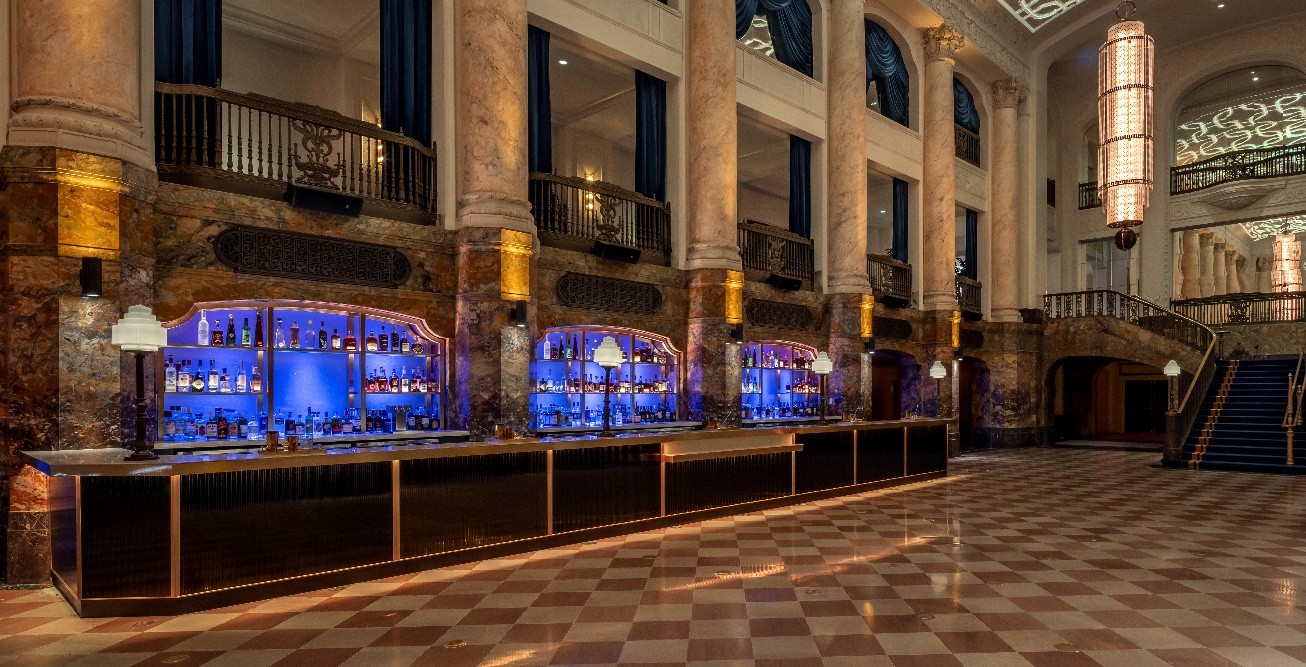
Hidden behind successive renovations that concealed much of its original design, the Brooklyn Paramount Theater has re-emerged with its historic character restored. The nearly century-old venue has been reimagined as a contemporary live performance space through a restoration led by global design and consultancy firm Arcadis in partnership with Live Nation. Central to the project was a strategic selection of materials that incorporated new elements designed to complement the theater’s architectural legacy while supporting the needs of a modern entertainment venue. Bendheim’s decorative glass, inspired by the building’s original character, helps achieve that balance.
Originally opened in 1928 as one of Brooklyn’s first sound pictures theaters, the Paramount later became a cultural landmark for jazz, hosting artists including Ella Fitzgerald and Duke Ellington. Decades later, the building was converted into a gymnasium for Long Island University.
“When we first stepped into the space, there was very little left of the original finishes,” says Associate Principal at Arcadis Keith Wlosek. “What is now the front door was a cafeteria and commercial kitchen. It was essentially a blank slate.”
The discoveries continued throughout construction. A mosaic appeared inside an IT closet. Another, featuring a curved peacock motif, was uncovered and preserved near the entry sequence. Former staircases, sealed during earlier renovations, were found behind walls and altered how circulation through the building was understood.
“It was a constant sense of discovery,” Wlosek says. “Every time we opened something up, there was another layer of the building’s story.”
Bendheim's role
In the Grand Foyer, Bendheim architectural glass plays a central role within the redesigned interior. The material was incorporated into a new bar installation to anchor the space while supporting Live Nation’s vision for a contemporary entertainment destination. Developed with a brass toned wire detail, the glass reflects the warmth of the original palette.
“We implemented this beautiful Grand Foyer bar, and it really serves as an anchor to that space,” says Wlosek. “In order to make sure that it didn't feel like a blank wall in the corridor side, that's where we use the Bendheim glass. We used the glass in a way that you could identify that there were bottles behind it when you're standing on the corridor side, but you weren't actually able to read the labels.”
Beyond the Grand Foyer bar, Bendheim glass was also incorporated at the ticket booth, where a mirrored backing was used to enhance light and openness within the space. The glass was intentionally adapted across different areas of the foyer in different ways to suit each location while still creating a cohesive look across the interior.
“We were very specific about brass because we wanted to bring in the blues and golds of the space and make it feel rich and elegant, while still giving it a modern twist,” Wlosek says. “Around the ticket booth, we wanted to make sure that it was as light and airy as possible, so the glass has a mirror back into it, as opposed to the glass where we put it on the back bar, where we wanted to be able to have that light transmittance. We really played with where it was used and how it was used, in order to make sure it was the best application in all in every application.”