Introduction to Fire-Rated Glazing
Benefits and standards of fire-rated glazing
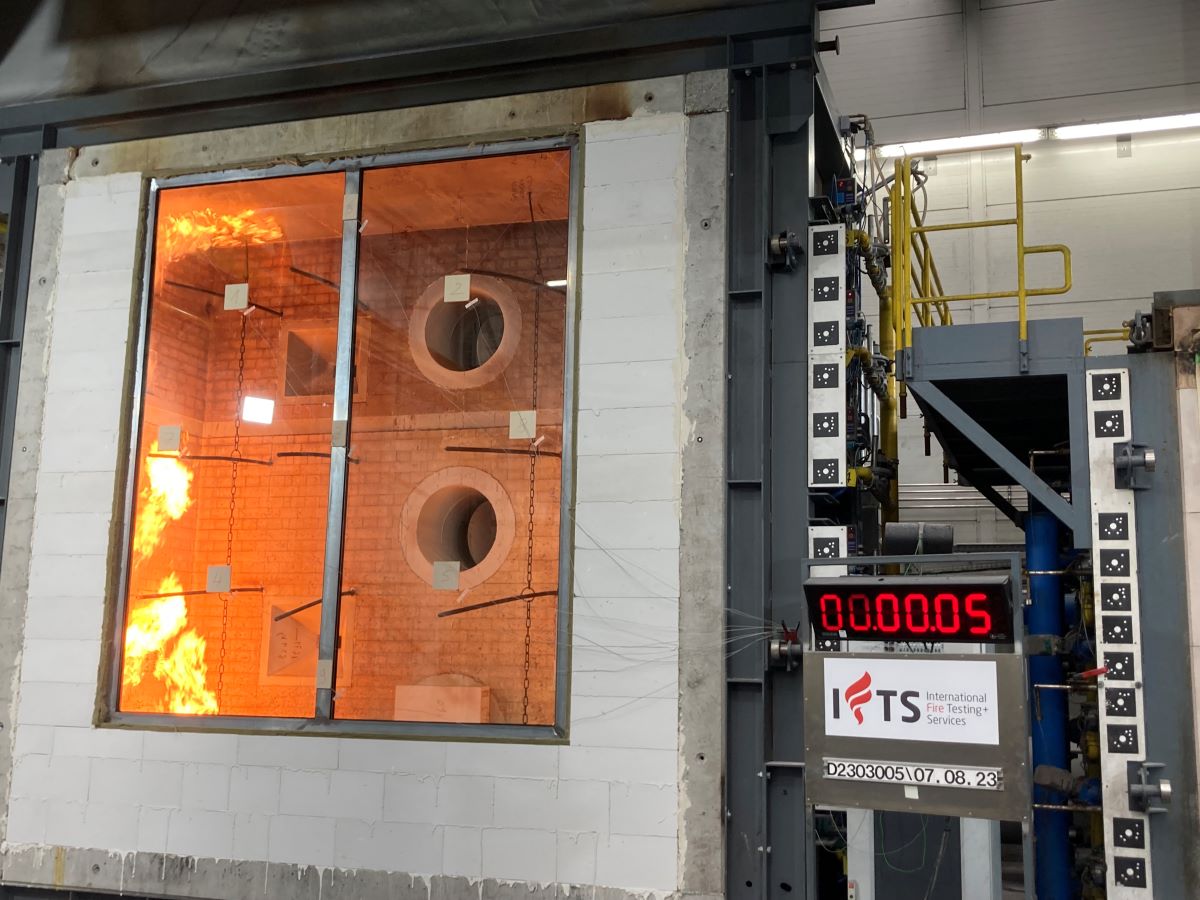
Above: Fire tests conducted to ensure that the Contraflam One product can withstand extreme heat and force. Photo courtesy of Vetrotech Saint-Gobain North America.
Excerpted from NGA Glass Technical Paper FB76-23 Fire-Rated Glazing 101, available for free download.
Fire-rated glazing systems offer benefits to building occupants and design beyond protection from accidental fire. Fire-rated glass provides the benefit of daylight, transparency, and additional security—meeting fire-safety and life-safety requirements while providing aesthetically pleasing views.
Fire-Rated Glazing Basics
Fire-rated glazing is unique in that it is specifically designed to control the spread of flames, smoke, hot gases and, if necessary, heat transfer from one area of a building to another. It performs critical life safety functions by allowing building occupants to safely exit a building in the event of fire, while allowing first responders to enter the building.
All fire-rated glazing is tested, listed and labeled under the follow-up services of nationally recognized testing laboratories. To list and label products as fire-rated glass, manufacturers must submit them to a certified laboratory for testing, which includes: (i) fire endurance testing lasting from 20 minutes to 3 hours, (ii) thermal transfer testing, if necessary, and (iii) hose stream testing in most cases. If the product passes the required tests, the test lab awards it a listing and label either as fire-protection or a fire-resistance rated glass.
Fire Endurance Test
All fire-rated glass is subjected to a fire endurance test. This determines the length of time, in minutes or hours, that the fire-rated assembly will withstand the fire of a test furnace which can exceed 1,900 degrees Fahrenheit. The fire in the test furnace follows a fixed time and temperature curve designed to simulate an actual fire in which temperatures rise quickly, then gradually increase over time. To be listed and labeled, the glass and its entire assembly must remain intact for the full duration of the test which can last from 20 minutes to three hours, depending on the type of listing required.
Hose Stream Test
Immediately following the fire endurance test, the glazing assembly is subjected to a hose-stream test, where the water pressure is 30-45 pounds per square inch, depending on the fire rating. Water from a fire hose playpipe strikes the assembly in a prescribed pattern and duration, depending on the size, from 20 feet away. If the glass remains in place without exceeding the allowable limit of openings, it passes the test. Most, but not all, fire-rated glazing applications require the hose stream test. In the U.S., in 20-minute fire door assemblies installed in 1-hour fire partitions, e.g. corridor walls and smoke barriers, the protective glazing shall be exempt from the hose stream test. In Canada, all fire-rated glass must pass the hose stream test.
Fire Protective vs. Fire Resistive: The Difference
Two classifications exist for fire-rated glass: fire-protective (or fire- protection rated) and fire-resistant (or fire-resistance rated). This terminology is important because it conveys the fire performance level of the glass relative to applicable code requirements. In addition, these terms are referenced by special letter designations, both on the laboratory label that is affixed to the glass and in Tables found in Section 716 of the International Building Code. Matching the performance level found on the label affixed to the glass and in the Tables found in the IBC enables architects, glaziers, code officials and other stakeholders to be sure that the correct fire-rated glass is being used in the right location.
Fire window and fire door assemblies are referred to in the IBC as "opening protectives." Fire windows and fire doors can be designed using fire-rated glass to prevent the passage of smoke, flames, hot gases, and, if necessary, heat or thermal transfer.
Fire protective glazing is tested to NFPA 257 Standard on Fire Test for Window and Glass Block Assemblies or UL 9 Standard for Fire Tests of Window Assemblies in fire window assemblies and NFPA 252/UL 10C and NFPA 252 Standard Methods of Fire Tests of Door Assemblies, UL 10C Standard for Positive Pressure Fire Tests of Door Assemblies, or UL 10B Fire Tests of Door Assemblies in fire door assemblies.
Fire-resistive glazing is tested as a "wall" assembly to ASTM E119 Standard Test Methods for Fire Tests of Building Construction and Materials or UL 263 Fire Tests of Building Construction and Materials. Like opaque fire-rated construction materials, fire-resistance rated glass is designed to prohibit the passage of smoke, flame, hot gases and the radiant heat from a fire.
Just like fire-protective glazing, fire-resistant glass is subjected to a fire endurance test and a hose stream test. The difference is that during the fire endurance test, thermocouples are placed on the surface of the glass on the non-fire side to measure the heat transmitted through the glass. The average temperature calculated from these readings cannot exceed 250 F, nor exceed an individual temperature rise of 325 F, above the initial starting temperature for the entire duration of the test.
NFPA 80 Standard for Fire Doors and Other Opening Protectives is the installation and maintenance standard regulating fire rated glazing.
NGA thanks our task group volunteers for updating this resource: Devin Bowman, Robert Carlson, Dan Cosentino, Kremena Doytcheva, Jim Gulnick, Emily MacNeil, Tim Nass, Kayla Natividad, Michael Nicasio, Daniel Poling, Jose Rodriguez, Diana San Diego, Melissa Szotkowski, David Vermeulen and Rick Wright.