
GFAB Workshop Takes Tempering Quality Hands-On
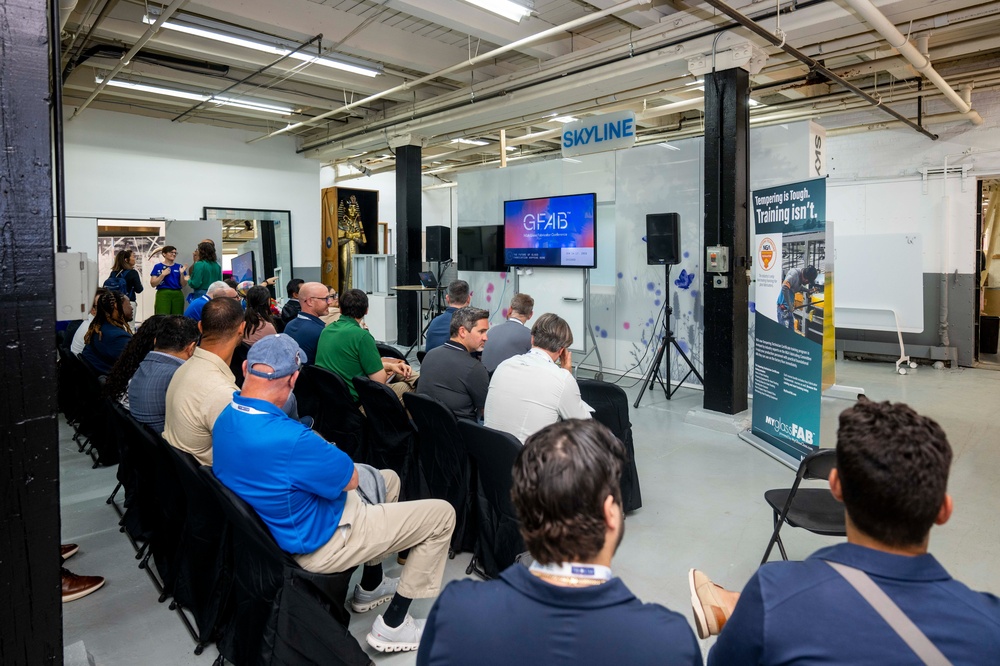
There are educational conference sessions, and then there's learning from standing beside a running tempering line as glass exits the "quench." For the second day of the National Glass Association's Glass Fabricator Conference, GFAB traded the general session room for the plant floor, welcoming GFAB Workshop attendees into Skyline Architectural Glass in Chicago for a full day of on-site classroom learning and hands-on workshops built entirely around quality and training in tempering.
Built from the floor up
The Workshop grew straight out of what NGA heard while planning the conference. "In our many discussions with glass fabricators during our planning process, we heard again and again that companies need more education and training directly addressing the needs of the factory floor," says Katy Devlin, NGA's chief content officer. "Based on that feedback, we are delivering NGA's first-ever in-plant education track, the GFAB Workshop."
It is the first of many such workshops that NGA hopes to host, each one inviting fabrication leaders into a glass plant for a day of hands-on, in-person learning. This inaugural session focused on quality control in glass tempering, sending an exclusive group of attendees throughout the Skyline facility to address the common challenges of tempering, from roller wave to bow and warp, and to learn about advancements in tempered glass quality control.
The day was hosted by Skyline and sponsored by LiteSentry-Softsolution-Strainoptics, which used an Osprey scanner on Skyline's tempering line specifically for the event, giving attendees a live look at automated, inline quality control rather than a slide about it. As Skyline President and CEO Vipul Bhagat told the room in his welcome, the facility has spent more than four decades fabricating glass, much of it inside a building over a century old. "We're very proud of what we do here. Hopefully today will be the first of many," says Bhagat. "Ask questions. We love that."
Setting the stage in the classroom
Things started off with a morning classroom session, where Katy Devlin walked attendees through what to expect, then handed off to a lineup of subject-matter experts. Mitch Majewski of the Safety Glazing Certification Council explained how third-party certification works under the ANSI Z97.1 standard, from the impact test to the center-punch test, and why that paper trail matters when codes, specifications and litigation come into play.
Jenni Chase, NGA's vice president of workforce development, made the case for structured training: in a recent NGA survey, half of fabricators named operator error and training gaps as their single biggest quality-control challenge on the tempering line. She introduced the new MyGlassFAB Tempering Technician Certificate, which is roughly three and a half hours of online, task-based instruction delivered in 15-minute segments, available in English and Spanish, and developed by tempering experts working on fabrication floors today. "This training was developed by our industry. It's not generic, it was built by the tempering experts on our fabricating floors," says Chase. "If you're not training your people on your biggest investment, you're leaving money on the table."
Nate Huffman of LiteSentry-Softsolution-Strainoptics closed the classroom portion with the economics, walking through the industry's estimated 8% to 14% loss to poor quality and the roughly $180,000 in avoidable annual losses that disciplined quality control can recover. "We always want to increase throughput, but not by sacrificing quality," says Huffman. "Catch rejects internally because once it leaves your building, you're paying at least three times the cost."
Onto the tempering line
Following the first introductory session, in two round-robin rotations, smaller groups moved through six stations led by experts from Glaston America, LiteSentry-Softsolution-Strainoptics and the Safety Glazing Certification Council. The first rotation tackled roller wave, seen first as a full run of the line, then up close through automated Osprey measurement and manual methods. The second focused on the defects that quietly drive waste and rejected shipments—surface-stress readings, bow measurement and cullet counting, demonstrated both manually and through automated tools.
A rooftop sendoff
A tour of the Skyline facility followed, capping a day that connected the why, the people, the process and the profits of getting tempered glass right. Attendees closed out the full day of learning on Skyline's rooftop at The Skyline Social Hour, sponsored by DeGorter Inc.
Discover more
To learn more on identifying and measuring roller wave distortion, be sure to check out Jenni Chase's recent article in Glass Magazine, or learn more about the new MyGlassFAB Tempering Technician Certificate.