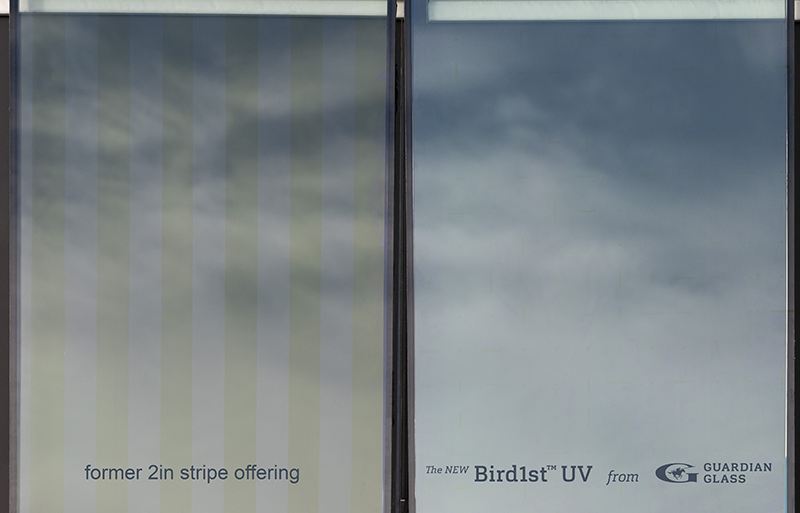
Guardian Glass is introducing the new Bird1st UV glass, an update to its bird-friendly glass portfolio. Engineered to support new building requirements while helping to preserve views and reduce the cost of installed IG units, the new solution offers the least visible-to-humans option within Guardian Glass’ bird-friendly portfolio, while meeting the Threat Factor ≤25 required by New York City’s Local Law 15 and other municipalities in the United States.
Human-centric bird-friendly glass
Guardian Glass has developed the new Bird1st UV solution with an emphasis on human visual comfort and façade aesthetics. A patterned UV-reflective coating is applied to the exterior surface of the glass, a placement shown through research to be the most effective for bird-friendly materials, where the patented coating can reflect upwards of 75% of UV spectrum light. To further enhance UV visual contrast, Bird1st UV incorporates a laminated interlayer on the second surface that absorbs more than 99% of UV light outside of the patterned areas. Because ultraviolet light falls outside the visible spectrum for the human eye, these features remain discreet to occupants and support clear, open views, allowing architects to design a unified glazing appearance across the façade.
In addition to being extremely difficult to see for humans, the new pattern is non-directional and available in split jumbo (130 inches by 102 inches), jumbo (130 inches by 204 inches), and super jumbo (130 inches by 240 inches) sheet sizes. Both the larger dimensions and non-directional pattern can help optimize cutting yields during fabrication and reduce the overall cost of the final glazing compared to the first-generation Bird1st UV product.
Performance and design
The product has been approved by the American Bird Conservancy (ABC) in combination with a broad range of Guardian SunGuard low-E coatings, including SNX 70+, SNX 60+, SNX 62/27, SNX 51/23, SN 68 and Neutral 78/65. Bird1st UV is available on Guardian UltraClear low-iron glass and Guardian Clear glass substrates—offering architects and facade designers an extensive range of energy performance, light transmission, and aesthetic options. In addition, the laminated glass can also provide further benefits, including enhanced security performance and improved sound control.
The new Bird1st UV has also been tested in combination with a variety of European SunGuard coatings. This compatibility can support international project teams working across regions, offering consistent performance options for North American specifications, while also allowing consideration of the solution for projects in other regions, subject to local requirements.
What people are saying
“We’re seeing a steady rise in demand for bird-friendly glazing as awareness of collision risks continues to grow across the architectural community,” says Director of Commercial Demand Creation, North America, at Guardian Glass Alan Kinder. “Project teams are increasingly focused on solutions that balance performance, design, and stewardship, while helping meet emerging local building codes that require bird-friendly glazing to support collision mitigation.”
“Developing a glass solution that meets building requirements while preserving the transparent, open aesthetic architects value is a significant technical challenge,” says Vice President, Global Product & Sector Management at Guardian Glass Suresh Devisetti. “Our Guardian Technology and Development team applied advanced material science and precision pattern design to create a UV solution that is virtually invisible to humans while passing ABC’s comprehensive testing processes. This work reflects the team’s ongoing commitment to innovation and to developing technologies that help meet both performance and design expectations. With a wide range of available coating and substrate combinations, Bird1st UV provides facade designers with a solution that supports energy efficiency, building code compliance, and architectural intent.”