Guardian Glass, Press Glass and Sunrise Erectors Collaborate on Project
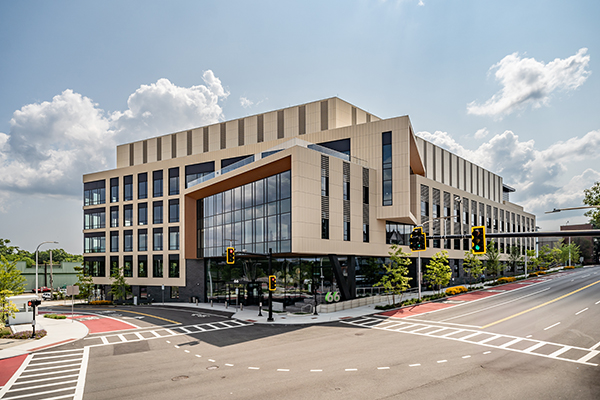
66 Galen Street in Watertown, Massachusetts, was designed by Elkus Manfredi Architects, featuring glass manufactured by Guardian Glass, fabricated by Press Glass Inc., and installed by Sunrise Erectors. The Class A lab and research life science building spans 224,000 square feet.
This facility offers health and wellness amenities, retail spaces, lounge areas and views of the Charles River. 231 custom 13/16-inch, low-iron and SGP laminated glass fins spanning over 13 feet tall are a feature added to this job, and they presented a new fabrication challenge for Press Glass.
Challenge #1: Figuring out the fins
Fabrication of the 231 long, narrow glass fins was a difficult task. These fins, crucial for the building's aesthetic and functional design, required precise tempering expertise to avoid issues such as bowing or curving post-heat treatment. “Everyone was especially mindful of the fins because quality is top priority, and ensuring there is no bow in 231 very skinny units would be a task,” says Brooke Earles, Senior Estimator/Project Manager at Press Glass.
"Initially conceived as a means of shading the south and east portions, the fins might provide enough shade to enable the occupants to keep their shades up for an additional few hours a day,” says Tim Talun from Elkus Manfredi Architects. Keeping the shades up in the morning sun would help preserve views toward a new park on this side of the building and the Charles River beyond.
Brian Kennedy, Press Glass sales representative on the project, highlighted the importance of balancing engineering and aesthetics. “We submitted several fin samples to the architect that were fabricated using different techniques such as laminating with colored interlayers or digitally printed acid etch simulation in effort to meet the aesthetic and functional goals.”
Solution: High quality fins
To ensure the quality of the unique fins, Press Glass implemented additional quality checking procedures at the end of the tempering furnace. “Each piece was measured by an inline scanner as well as manually by quality inspectors. It was equally as important to refine the furnace recipe used for the fins to lessen the chance of bowing while the pieces were traveling through,” says Adrian Wezgowiec, Quality Manager at Press Glass. Moreover, a full-sized visual mock-up was provided to Sunrise Erectors for review before finalizing the order. Brian Kennedy emphasized the collaborative effort between Press Glass and the designers. “We were more involved in the design work on the fins because they were more flexible on finding the right mix.”
Challenge #2: Unexpected change of plans
Another challenge arose late in design when the glass coating selected was discontinued. This could cause potential issues in the future should there be a need for replacement glass. Making a new selection was a “pivotal point” in the project’s journey according to Leah Perez Hemling, project manager at Guardian Glass.
"The glass was important to the overall aesthetic of the building and controlling solar heat gain. The change in glass, the discontinuation of the glass type, and working with Guardian quickly to get a range of samples were pretty important in helping us establish clear expectations with all stakeholders when making the decision on another glass type," says Talun.
Solution: New glass coating
Perez Hemling emphasized the need to understand project specifics. “It’s very important to me to know what the criteria of the architect is and to know what the criteria of the project is.” In this situation, a new glass selection was paramount, and the selection needed to be made quickly.
“We ended up taking along with our client a trip to New Jersey to view a mockup of the glass that was discontinued and the new glass option which was important to making the decision," says Talun. Ultimately, SNR 50 was selected to replace the discontinued product.
The results
The collaborative efforts between Press Glass and Sunrise Erectors and quality methods at Press Glass led to the successful fabrication and installation of the glass fins. “We thought the fins would be a challenge, but our team went above and beyond to ensure they ran through production beautifully,” says Earles.
“The fabricated hole lined up perfectly where we needed it to because there was a very specific custom outrigger that we were attaching to on the curtain wall,” says Matthew O’Brien, Project Manager at Sunrise Erectors.
The installation process was smooth, with O’Brien highlighting, “The job was a huge success, we ordered just over 1,400 units and needed very few replacement units. The need was not due to fabrication but incidences in transport or on the job site.”
The quality requirements were more stringent regarding distortion and anisotropy due to the location. The U-value parameters in New England are some of the tightest in the country which is why IS 20 was selected to drive the U-value down. The two coatings worked (IS 20 and SNR 50) together to achieve the aesthetic vision and lower solar heat gain.
“The job was a huge success with only a couple of remakes but other than that everything went great and that is largely due to the great coordination of Matthew [O’Brien] and Eric [Pitts] with Sunrise Erectors. The order releases were complete, which streamlined the shipping process. We had ample lead time and clear directions regarding expectations for packaging and shipping. We also made a great connection with the company who was receiving the glass in Canada which also helped things progress smoothly,” says Kennedy.