For a New York City commuter station, Bendheim stepped in with design-assist services and its fastening system holding nearly 1,800 square feet of glass.
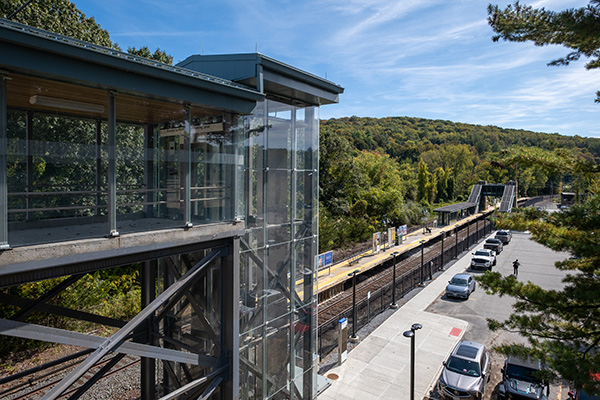
Originally constructed in the mid-19th century, Purdy’s Station serves generations of commuters travelling throughout Hudson Valley and into New York City. Recent improvements, completed as part of a system-wide accessibility effort by the Metropolitan Transportation Authority (MTA), introduced new vertical circulation and pedestrian connections, including elevators and fully American Disabilities Act (ADA) compliant walkways linking the parking areas, Route 116 overpass and station entrance.
“Safety is of paramount concern for Metro-North, and it is mandatory we achieve the least obstructive views when designing a station and access to a station,” says Technical Principal at AECOM Neils Benavides.
Project details
The Purdy Station project reflects the type of public infrastructure upgrade undertaken regularly across transit systems nationwide, according to Bendheim officials. For these projects, practicality, cost and ease of installation are key. Bendheim’s Wall F-20 Glass System was selected as a proven rainscreen solution that meets these demands while still delivering aesthetic value.
The site’s sloped topography and proximity to roadways required an enclosure that could ensure pedestrian safety without overwhelming the station’s rural settings. Bendheim’s Wall F-20 Glass System creates a minimally intrusive barrier, maintaining clear sightlines while allowing natural light to pass through and preserving views of the surrounding farmland and forested terrain.
“During the shop drawing period, Bendheim was extremely helpful coordinating details with the project particulars, a wonderful experience and great service,” says Benavides. “Coordination with Bendheim and the architectural and structural framing elements was essential. Bendheim’s multi-dimensional drawings supported the clashes and avoided delays and redoing work.”
Bendheim officials say the Purdy’s Station project illustrates how a well-designed rainscreen system can serve as a reliable, economical solution for recurring infrastructure needs. It balances safety, performance and aesthetics without unnecessary customization, and by leveraging a system engineered for efficiency and supported by design assistance, project teams can achieve consistent results while controlling costs.
The Purdy’s Station project demonstrates how a thoughtfully engineered rainscreen system can turn everyday infrastructure into a functional, visually cohesive solution. Pedestrians move safely through well-lit walkways, sightlines remain clear and the enclosure complements the surrounding landscape.