
NSG Group Successfully Demonstrates Manufacturing Float Glass Using Waste Glass
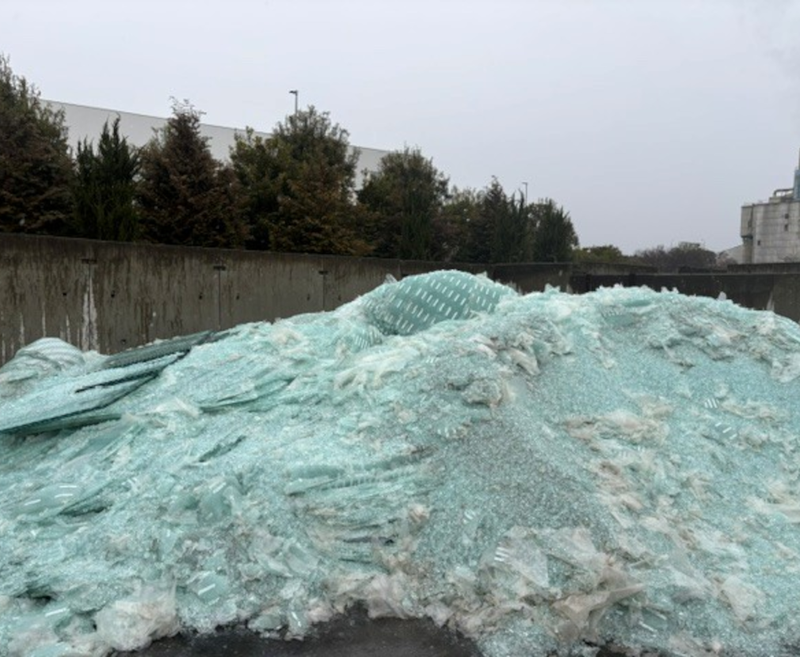
NSG Group announced the successful completion of a demonstration project to manufacture float glass using waste glass recovered from renovation projects. The project was conducted in collaboration with the Flat Glass Manufacturers Association of Japan.
As part of this initiative, waste glass removed from a building owned by The University of Tokyo was collected jointly with the Association. The recovered glass consisted of 12 millimeter-thick ceramic-printed tempered glass with safety film. The project aimed to achieve horizontal recycling, whereby end-of-life glass is recycled back into new float glass products.
The recovered waste glass was sorted by an intermediate processing company, and glass from which the safety film had been removed was fed into the float furnace of its Chiba Plant in Ichihara City, Chiba Prefecture, in late August 2026. Manufacturing trials were conducted, along with evaluations of product quality and operational impacts on the production process. The results confirmed that, under certain conditions, the recovered material could be used successfully as a recycled raw material without adverse effects. This demonstration verified the feasibility of producing float glass in Japan using post-consumer glass collected from the market.
In addition, glass that could not be recycled into float glass due to the presence of safety film was diverted to an alternative recycling route, where it was processed and utilized as a raw material for glass wool production through an intermediate recycling company.
In glass manufacturing, glass cullet generated during production and recovered before reaching the market has long been recycled almost entirely back into the glass manufacturing process, says NSG.
However, the use of waste glass (post-consumer cullet) generated from building demolition or end-of-life vehicles as a raw material presents significant technical challenges. Contamination by foreign materials such as metals can lead to production losses, and even trace impurities can have a substantial impact on product quality and furnace operations, particularly in float glass manufacturing, which accounts for most of the architectural and automotive glass production. As a result, most post-consumer cullet collected from the market has traditionally been treated as industrial waste.