
Architect’s Guide to Protective Glass
Glass systems can offer security and life-safety without compromising occupant comfort
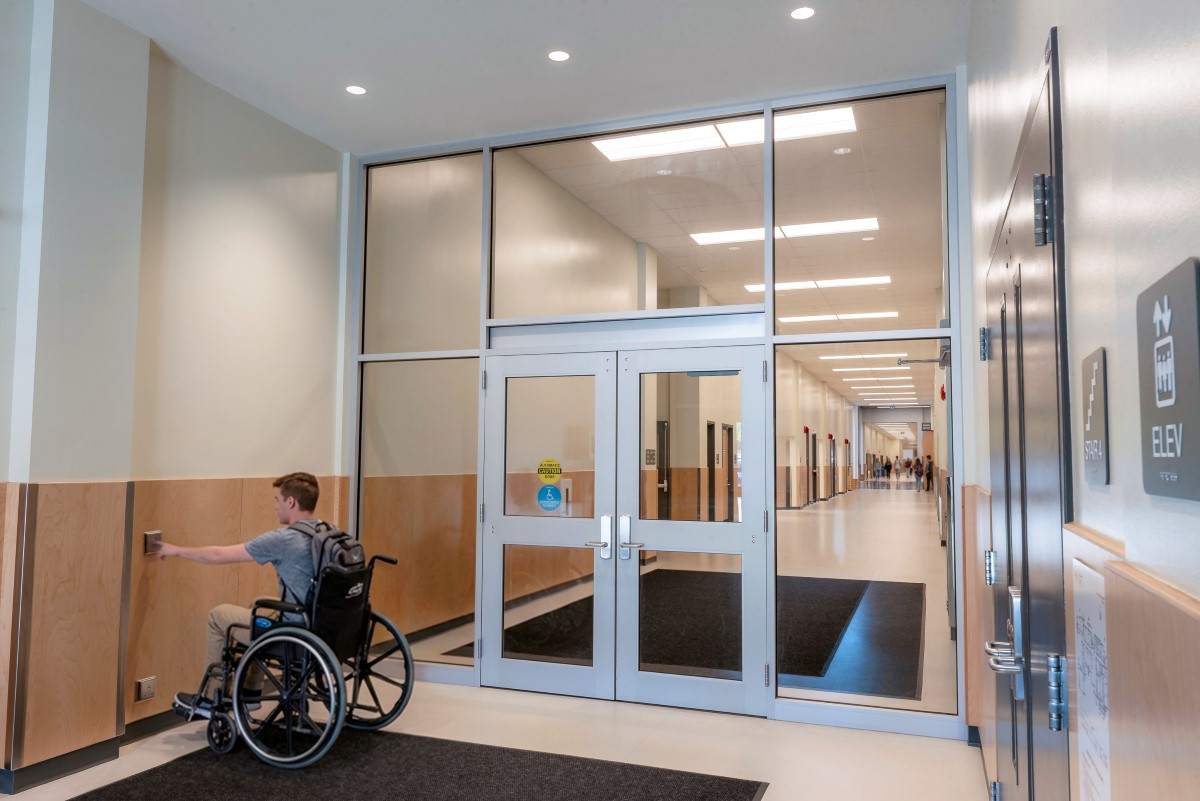
Above: Eric Hamber Secondary School in Vancouver, British Columbia, was recently renovated in order to address multiple goals for occupant safety and wellbeing. The school’s new design includes fire-rated glazing systems, courtesy of TGP, which allow light from the exterior, non-rated curtain wall to filter deep into the building’s interior, providing multiple light-filled common areas for students to socialize or study. It also supports compartmentation efforts and meets code requirements for fire barriers. Specifying the Fireframes SG Curtainwall Series with Pilkington Pyrostop fire- and impact-rated safety glass from TGP, the project team was able to maximize the spans of glass used in the assembly and create a monolithic structural glazed appearance, say officials. Because the frames of both systems are visible from the entry and third-floor landing, using an interior, fire-rated curtain wall with narrow-profile frames preserves a cohesive design throughout the building.
In January 2025, the Palisades and Eaton fires burned through California with catastrophic results. In the end, 30 people were killed and 17,000 buildings burned. The fires caused $30 billion in property damage and $250 billion in economic loss.
The fires were just one event that made clear the need for building materials that protect structures and the people who live, work and learn inside them. Glazing systems can help protect buildings and people without compromising occupant comfort.
What is protective glazing?
Protective glazing has various definitions depending upon the context in which it is used. It can cover glazing designed to minimize injury and property damage from bullets, blast waves and/or physical attack. It can also indicate glazing designed to protect people and property from windborne debris associated with hurricanes.
Depending on the product make-up, protective glazing can also fulfill a range of other performance criteria, such as blocking the spread of smoke and flames, reducing unwanted noise, and insulating against heat gain and loss for improved building energy efficiency. Urmilla Sowell, vice president, advocacy and technical services at the National Glass Association, emphasizes that unlike traditional security measures, protective glazing options also help to maintain occupant comfort. “Traditional security measures can make places feel institutional, unwelcoming or even just remind us that there is a safety need to be met,” she shared in the presentation “Glass to Protect,” offered at GlassBuild America 2026. “High walls, minimal windows and restricted sightlines are traditional approaches that we may have seen as safe, but they compromise the psychological benefits of daylight, views and connection.”
Protective and security glazing is a powerful design tool, she says, because these systems allow designers to maintain the transparency and openness that support well-being, while still providing the protection occupants need to feel—and be—safe.
1. Security Glazing
Security glazing is designed to remain intact after breakage. Security glazing systems can be used to protect against smash and grab crimes, firearms, blasts and more. It is important to understand how this type of protection differs from safety glazing:
-
Safety glazing has passed ANSI Z97.1 testing to reduce cutting and piercing injuries when broken with accidental human impact.
-
Security glazing tends to be defined as glass that resists intentional attack to provide safety and/or time for reaction.
One of the consistent characteristics between the two applications is the ability to keep glass shards small enough to reduce injury, or to keep it in-place and deter immediate penetration. That typically occurs by tempering the glass or using a material that is attached to the glass to enhance its performance. Tempered glass is known to break in small pieces, and when appropriately processed, is therefore deemed as a safety glazing. However, once broken, it does not provide penetration resistence, which comes from the use of surface-applied films, interlayer films or curing resins.
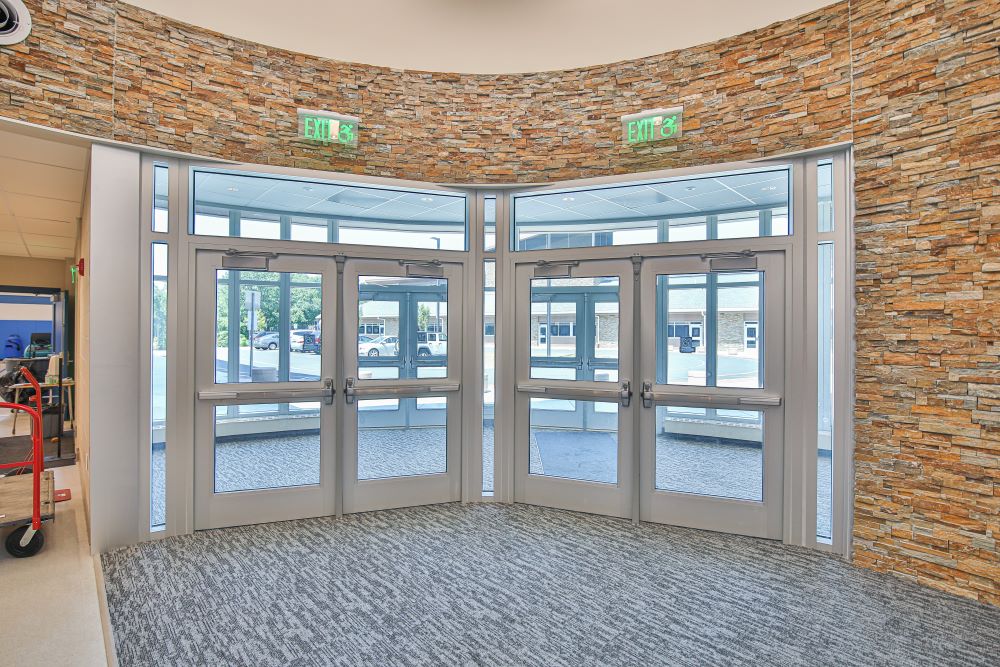
An overview of security glazing
Security and protective glazing systems and assemblies can offer protection against a multitude of threats, both internal and external to the space. Many window, door and curtain wall manufacturers have systems tested with security glazing. More information is available from these manufacturers.
Here is an overview of types of security glazing and how they function:
-
Burglary-resistant glazing can be a deterrent to smash-and-grab crimes. Burglary-resistant laminated glass typically consists of two layers of annealed, heat-strengthened or tempered glass bonded together by a 0.060inch or thicker interlayer. The glass can be installed into insulating glass units for improved thermal performance. Burglary-resistant glazing may also include self-adhesive polyethylene terephthalate films that are on the exposed, interior side of the glass.
-
Forced-entry-resistant glazing can be used in detention facilities or other installations with a high risk of attack, and may also resist penetration from hand-held or hand-thrown objects such as hammers, crowbars, bats, knives, bricks and rocks.
-
Bullet-resistant glazing is designed to resist penetration from a variety of firearm ammunitions. There are numerous types of bullet-resistant laminated glazing, including all-glass laminates, glass-clad polycarbonate laminates, glass laminates containing other rigid polymers, laminated polycarbonates, and glass/exposed plastic laminates (exposed polycarbonate or PET). Bullet-resistant glazing must be tested in accordance with standard procedures to demonstrate its ability to resist a specific ballistic threat level. Bullet-resistant glazing provides an improved safety barrier against bullets and related flying glass or plastic fragments, such as spall or splinters.
-
Multiple forced-entry assault (ballistics and forced entry) products are designed to combine the resistance of ballistic classified laminates with additional resistance to forced entry. Testing for these glazing systems involves weakening the sample by ballistic assault, but not allowing the bullets to penetrate. The glazing is then tested to withstand physical impact and attack with various weapons. This glazing would carry a ballistic and forced-entry classification and would be used in very high-risk areas where intruders may be armed with guns.
-
Blast-resistant glazing can substantially reduce injury from flying glass resulting from direct-blast shock waves, or overpressures. When properly designed, framed and anchored, blast-resistant glazing is capable of maintaining the integrity of the building envelope following an explosion and reducing interior damage. Low-level, blast-resistant, laminated glazing typically consists of two layers of glass bonded together by a 0.030inch or thicker interlayer. For higher level blasts, thicker constructions may be needed. The glass can be annealed, heat strengthened or fully tempered. The glass can be installed into insulating glass units for improved thermal performance.
-
Hurricane-resistant laminated glazing reduces the effects of windstorms on buildings by preserving the integrity of the building and preventing glass particle fallout. Hurricane-resistant laminated glazing may offer some level of burglary or forced-entry resistance but typically are not bullet-resistant without further specification of a ballistic threat level.
The U.S. General Services Administration developed a training program that addresses emergency egress through security glazing. Architects specifying systems and schools installing security windows need to be aware of the potential time needed to get through security glazing.
Considerations for school security
According to Everytown for Gun Safety and the K-12 Shooting Database, since 2013, there have been at least 1,322 incidents of gunfire on school grounds, resulting in 436 deaths and 936 injuries nationally. The average length of active shooter events is 8 minutes; the shortest is 90 seconds.
Security glazing is designed to buy time for first responders. Active shooter events happen most frequently in retail/commerce spaces, open spaces and education facilities.
Schools and institutions have responded to active shooter events in many ways in recent years. Districts are spending millions of dollars to “harden” schools, or adding more security elements and equipment, and students are spending more class time on active shooter drills. The Department of Homeland Security released documents to guide schools and districts on these new measures, and new school security requirements are under consideration at the federal level and in many states.
While these interventions help make schools safer, there’s more that glass can do to make schools secure. Protective and security glass and glazing systems have a part to play in keeping students safe while also maintaining a pleasant learning environment.
There are many reasons to use security glazing to protect students from active shooters:
-
Security glass installed in school entrances looks like a normal entrance and is perceived as a point of weakness, but can isolate those entering the building, slow an active shooter down and delay entry into the building as the first line of defense.
-
Windows can allow for line of sight, both exterior to interior and within the building, alerting school personnel and first responders of impending danger. Security windows can create safer spaces within the building. Opaque glass can provide privacy and allow light flow while selectively blocking the line of sight of attackers.
-
Windows can be designed for forced-entry resistance, bullet-resistance or both.
-
Retrofit options are readily available for existing windows.
-
Windows can create a secure environment, without it feeling like a secure environment to teachers and students, by protecting while being unobtrusive.
-
Security windows provide passive protection, continuing to function during power outages.
-
Students in classrooms with windows providing natural daylight and a view to the outside score 7%-30% higher in math and reading and have lower absenteeism.
In defense of daylighting
One of the major design benefits of protective glazing is that it also allows for daylighting, which is critical to ensuring psychological well-being for occupants.
Daylight has qualities that cannot be replicated by electrical or artificial light. The changing intensity, direction and color of natural light connects building occupants to the weather, season and time of day. Views through windows can stimulate the well-being and productivity of building occupants. With careful design and controls, daylighting can also substantially reduce energy use.
The potential for daylighting and views is largely a function of orientation, window placement and window area, as well as the windows’ visible transmittance. However, daylight admission must be balanced with glare control and thermal comfort.
Glazing can be separated into glazing for daylighting and glazing for views, while daylight is redirected by means of light shelves. Top lighting fenestration, such as roof monitors, can be another means of controlled daylight access. Advanced glazing for daylight control is available with electrochromic coatings or between-glass blinds. Finally, orienting glazing along an east-west axis typically reduces the potential for glare and allows for more balanced light conditions throughout the day.
2. Fire-rated glazing
Protecting against fire, whether wildfires or accidental interior fires, is a major design consideration. According to the National Fire Protection Association, 470,000 structure fires occurred in the United States in 2023, which amounts to 1,300 fires every day. The total damage includes:
- 3,070 deaths;
- 11,790 injuries; and
- $14.7 billion in property damage.
Fire safety requires a balance of two complementary approaches:
Active fire protection: This includes automatic suppression devices—sprinklers being the most common. Active systems detect and respond to fire. They’re incredibly important—sprinklers cut fire death rates by about 80% in buildings where they’re present.
Passive fire protection: This includes fire-rated glass, fire-resistant walls, fire doors and compartmentation. Passive systems don’t require activation—they’re always working.
Fire-rated: Fire-protective and fire-resistive glass
In commercial buildings, fire-rated glass enables safe egress through proper compartmentation and protected egress paths. All fire-rated glazing is tested, listed and labeled under the follow-up services of nationally recognized testing laboratories. In order to have their products listed and labeled as fire-rated glass, manufacturers must submit their products to a certified laboratory to be:
-
fire tested for periods lasting from 20 minutes to 3 hours,
-
thermal transfer tested, if necessary, and
-
hose stream tested in most cases. If the product passes the required tests, the test lab awards it a listing and label either as fire-protection or a fire-resistance-rated glass.
Two different classifications exist for fire-rated glass.
Fire-protective glazing is tested to NFPA 257/UL 9 in fire window assemblies and NFPA 252/UL 10C and UL 10B in fire door assemblies. Fire window and fire door assemblies are referred to in the International Building Code as “opening protectives.” Fire windows and fire doors can be designed using fire-protection-rated glass to prevent the passage of smoke, flames and hot gases.
Fire-resistive glazing is tested as a “wall” assembly pursuant to ASTM E119/UL 263. Like opaque fire-rated construction materials, fire-resistance-rated glass is designed to prohibit the passage of smoke, flame, hot gases and the radiant heat from a fire.
All fire-rated glass is subjected to a fire endurance test. This determines the length of time—in minutes or hours—that the fire-rated assembly will withstand the fire of a test furnace, which can exceed 1,900 degrees Fahrenheit. The fire in a test furnace follows a fixed time and temperature curve designed to simulate an actual fire in which temperatures rise quickly, then gradually increase over time. To be listed and labeled, the glass and its entire assembly must remain intact for the full duration of the test, which can last from 20 minutes to 3 hours, depending on the type of listing required.
Immediately following the fire endurance test, the glazing assembly is subjected to a hose stream test, where the water pressure is 30-45 pounds per square inch, depending on the fire rating. Water from a fire hose playpipe strikes the assembly in a prescribed pattern and duration, depending on the size, from 20 feet away. If the glass remains in place without exceeding the allowable limit of openings, it passes the test. Most, but not all, fire-rated glazing applications require the hose stream test. In the U.S., in 20-minute fire door assemblies installed in 1-hour fire partitions (e.g., corridor walls and smoke barriers) the protective glazing is exempt from the hose stream test. In Canada, all fire-rated glass must pass the hose stream test.
The ability to limit heat transfer is a critical distinction between fire-protective and fire-resistant. Fire-rated products are application-driven as much as they are code-driven. The duration rating should not be the sole feature determining code compliance. Fire-protective glazing is subject to various size and application limitations in the IBC because it does not prevent heat transfer. Where fire-protective glazing is limited or prohibited by code, fire-resistant glazing can be considered when evaluated for the end-use condition.
Protecting the means of egress
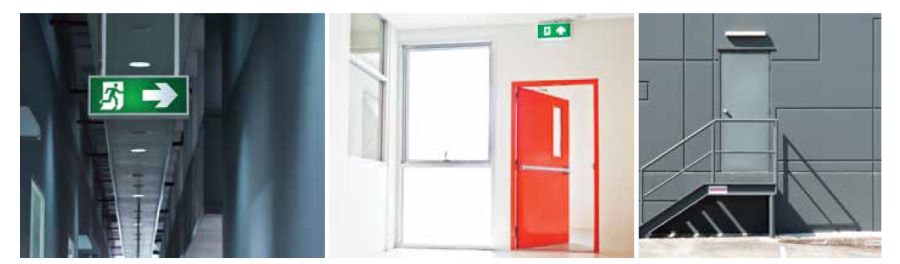
The means of egress is the safe way to exit a burning building. This includes not just the exit, but the entire protected path from where occupants are to the outside. Commercial buildings must have fire-rated glass to protect individuals along the path of egress.
First, the exit access. This is the portion from any occupied part of the building to an exit. It starts where an occupant begins egress travel, includes all the rooms and spaces they pass through, and ends when they reach the exit. This might include corridors, aisles and doorways. Fire-rated glass in exit access corridors allows natural light and wayfinding while maintaining fire separation.
Exit. This is generally considered the point where the occupant has attained a certain level of safety, like an enclosed stairwell or exit passageway, that’s separated from other building spaces. This is where fire-resistance becomes critical. The stairs occupants use to evacuate a high-rise are considered an exit, and must be protected with fire-rated construction, including any glazing.
Exit discharge. This refers to the exterior area at grade where an occupant leaves the building. Occupants are not truly safe until they’ve reached the public way.
At every point along this path of egress, any glass present must be appropriately fire-rated, including windows looking into the exit stairs or doors with glass.
Resources from the National Glass Association
This article was compiled using the following sources from the National Glass Association.