
Architectural Glass Recycling Turns Waste into Opportunity
How collaboration and circularity are transforming the building industry

Above: Infinite Recycled Technologies recently collaborated on a study with NGA and AEC to look at the potential impact of end-of-life recycling. The company worked with building ownership at a project in Rochester, Minnesota, to remove and recycle glass and aluminum from a parking garage slated for demolition.
Recycling architectural glass is not only possible, but also practical, cost-effective and increasingly embraced across the industry. This year’s GlassBuild America in Orlando served as a powerful example of what can be achieved when stakeholders unite around a common goal.
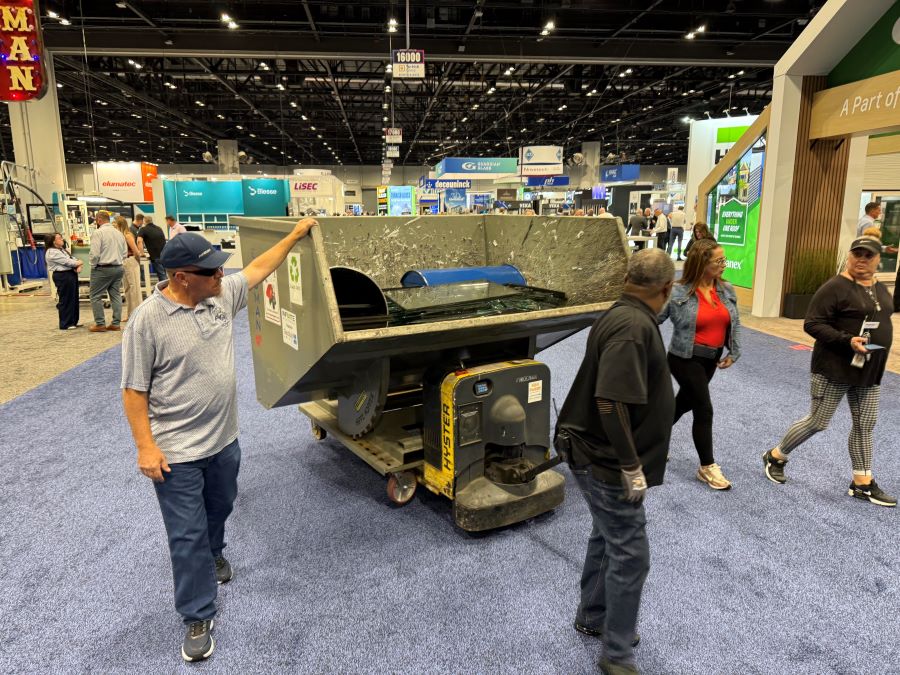
The glass industry trade show provided an opportunity to showcase glass recycling in action. Infinite Recycled Technologies partnered with the GlassBuild organizing team, the National Glass Association; Freeman, the show’s operators; and the staff of the Orange County Convention Center, where the trade show was held, to implement a recycling program on the show floor. The IRT staff engaged exhibitors to collect what ultimately amounted to 14.3 tons of glass waste—most of which would otherwise have gone to landfill but was instead recycled at IRT’s South Florida location.
Every ton of post-industrial and post-consumer glass diverted from landfills represents a tangible step toward sustainability. The challenge lies not in feasibility, as shown by the success at GlassBuild America, but in awareness and coordination.
Coordination amplifies circularity
Glass recycling is a cornerstone of circularity, offering significant environmental benefits. Glass is one of the few building materials that is infinitely recyclable without loss of quality. Architectural glass already plays a critical role in high-performance building envelopes during its use phase; with strategic collection and processing, it can continue to deliver value long after its initial application. Recycled glass applications can range from making new glass, fiberglass insulation, as well as a multitude of industrial applications. This approach extends the investment in the material, mitigates landfill impact and supports a version of sustainability that is both practical and scalable.
Using recycled cullet in glass production can also help mitigate carbon dioxide emissions. According to NSG Group “remelting of one [metric] tonne of cullet avoids approximately 400 to 600 kilograms of carbon dioxide emission.” Similar reductions are shared by Saint-Gobain Glass where they elaborate that for each ton of cullet used, their consumption of virgin raw material is decreased by 1.2 tonnes and lowers the energy needed for melting cullet by 30%, compared to melting primary raw materials. Using more recycled cullet in place of virgin materials in glass manufacturing reduces energy requirements and, as a result, fuels consumption and emissions.
Services offered by IRT include hauling and recycling glass from fabrication processes—whether monolithic, reflective/low-emissivity/ceramic-frit-coated, mirror, insulated, laminated or a combination thereof—and working with project teams recovering glass from building renovations, demolitions and fit-outs. Historically, these materials were sent to landfills; today, they can be redirected into productive reuse.
For over two years, IRT has enhanced efforts across the architectural glass value chain to dispel misconceptions that recycling is difficult, costly or uninteresting. The reality is quite the opposite: fabricators, developers, architects, contractors and building operators have shown strong interest in sustainable alternatives.
In New York City, industry stakeholders from a cross-section of the industry have joined together to collectively share experiences and connections related to glass recycling. Engagement with this group has allowed companies to facilitate new pilot projects to recover glass from various retrofit or repositioning projects in and around the New York City area.
In 2025, this initiative resulted in glass being recycled from about 20 projects, diverting about 800 tons of architectural and flat glass from landfills. The positive results seen in New York in 2025 can be attributed to the positive and proactive engagement of this industry glass recycling group, which offers members group support, project opportunity sharing and specifications writing for those projects and stakeholders wishing to enhance project sustainability objectives through waste mitigation and diversion plans and process. These project specifications can be written utilizing IRT’s guide specification or collaborating with architects/specifiers writing their own documents.
A recent project in Rochester, Minnesota, illustrates the potential impact of end-of-life recycling. As part of a study funded by NGA and the Aluminum Extruders Council, IRT collaborated with the building ownership and contractors to remove and recycle glass and aluminum from a parking garage slated for demolition. This effort not only diverted demolition waste but also allowed the team to better document recycling outcomes. The study provided the project team with more information about recycling and waste management rates, while also offering ideas about how teams can identify opportunities to recycle better and more effectively moving forward.
The success at GlassBuild America and projects like those in Rochester demonstrate that architectural glass recycling is not an abstract ideal, but an actionable reality. Through collaboration, education and commitment, industry can transform glass from a disposable commodity into a perpetual resource. By embracing circularity, we reduce carbon emissions, conserve energy and create a replicable model for sustainable construction practices.