
The Importance of Service Life for IGUs
Why design-related decisions are crucial for reducing environmental impact
Architectural and design firms, as well as some regulatory bodies, increasingly require environmental impact data for building systems. While designers are requesting carbon footprint metrics to quantify the embodied carbon of insulating glass units, the design community should also consider IGU service life—the estimated time an IGU can function before needing to be repaired or replaced. An understanding of service life, and how it relates to environmental impact, is crucial to capture the full carbon reduction potential of high performance IGUs.
Operational carbon and embodied carbon
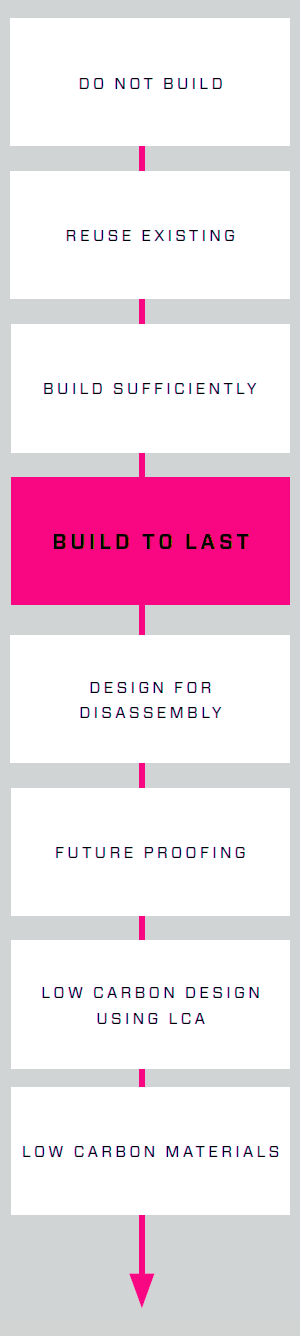
Carbon emissions for glazing systems are often measured through two metrics: operational carbon and embodied carbon. Both metrics are important to understand with regard to reducing building emissions.
Operational carbon, or OC, is the carbon emissions caused by operating a building. For most buildings, the improved energy efficiency of building materials results in reduced OC. However, this is not always the case—for example, when a building’s power is sourced from clean energy, such as on-site renewables or a low-carbon electric grid, even an energy inefficient building could have low OC.
Embodied carbon, or EC, is the carbon emitted during a product’s raw material extraction and manufacturing. Approximately 75% of an IGU’s EC is from energy-intensive flat glass production. Only 10% is due to the insulating glass process itself—approximately half from the electricity to run the IG line and half from the edge seal materials (spacer, sealants, desiccant).
Most factors that impact an IGU’s EC are those that glass fabricators cannot change. The project-specific IGU design itself determines the EC—the number and thickness of the lites, the heat treatment, as well as the edge seal materials specified. The fabricator’s location also impacts the product’s EC, depending on the electric grid’s carbon intensity. In addition, the dual seal polyisobutylene, or PIB, and silicone edge seal system is ubiquitous in commercial IGU applications. The quantities used are determined by durability needs and similar for all fabricators.
For IGUs, service life matters
IGUs have an important role to play in reducing both the OC and EC of a building. High-performance fenestration can play a significant role in reducing OC by reducing a building’s lifetime heating and cooling loads, assuming the fenestration’s efficiency performance does not degrade. These emissions reductions accrue through the building’s service life. Maximizing fenestration service life is therefore critical to maximizing accrued emissions reductions.
Extending the service life of an IGU assembly also plays a critical role in reducing a building’s EC. Securing a long service life for an assembly also preserves the large upfront EC investment in the flat glass used to make the IGU. For example, selecting an alternative product that halves the upfront EC, but also halves the service life, is not a better choice. Due to its shorter service life, the IGU will need to be replaced sooner, which then increases the overall EC for the building. EC per year of service life is an important (but not yet widely utilized) metric that should be used to support product selection.
Best practices for managing IGU service life
For these reasons, asking for the carbon footprint of IGUs from different fabricators to make supply chain decisions is not meaningful for project-level carbon reduction decision-making.
While the impact of IGU manufacturing on EC seems minor, the edge seal selection details and manufacturing quality have an oversized impact on service life, which is a driver of long-term embodied and operational carbon emissions.
An IGU’s service life is maximized if:
- Its edge seal is carefully designed to manage the environmental conditions and climate loads;
- Its edge seal uses high-quality spacer, desiccant and sealants in sufficient quantity, and if those materials are appropriate to the application and work effectively together as a system;
- It is manufactured with consistent and effective quality control; and
- It is carefully installed to effectively manage water, material compatibility and edge pressure, and provide sufficient edge support to manage shear and deflection.
Fabricator and installer certification programs—such as the IGCC/IGMA and IGMAC programs for IGU fabricators and the NACC and AGMT programs for installers—support quality fenestration designs, fabrication and installation. Choosing certified fabricators, IGU designs and installers can reduce service life risk, supporting improved performance and longevity.
Cautionary notes on the interplay between EC and OC
Dematerialization—the removal of carbon-intensive materials (such as metals) from component or assembly designs—is a strategy building professionals use to reduce EC and OC. However, this strategy can backfire if dematerialization reduces useful service life. A critical assessment of assembly and component service life in the application is important.
Also, reducing EC in fenestration often conflicts with reducing OC. For example, triple-pane fenestration typically reduces OC emissions but increases EC by increasing the amount of glass in the system. It’s therefore important for practitioners to complete a full life cycle assessment to understand if the reduction in OC emissions over the expected lifetime offsets the initial EC investment.