
The Shower Hinge Template Problem That’s Been Hiding in Plain Sight
A small change to a familiar 4-inch hinge template could eliminate one of frameless shower installers’ longest-running field frustrations
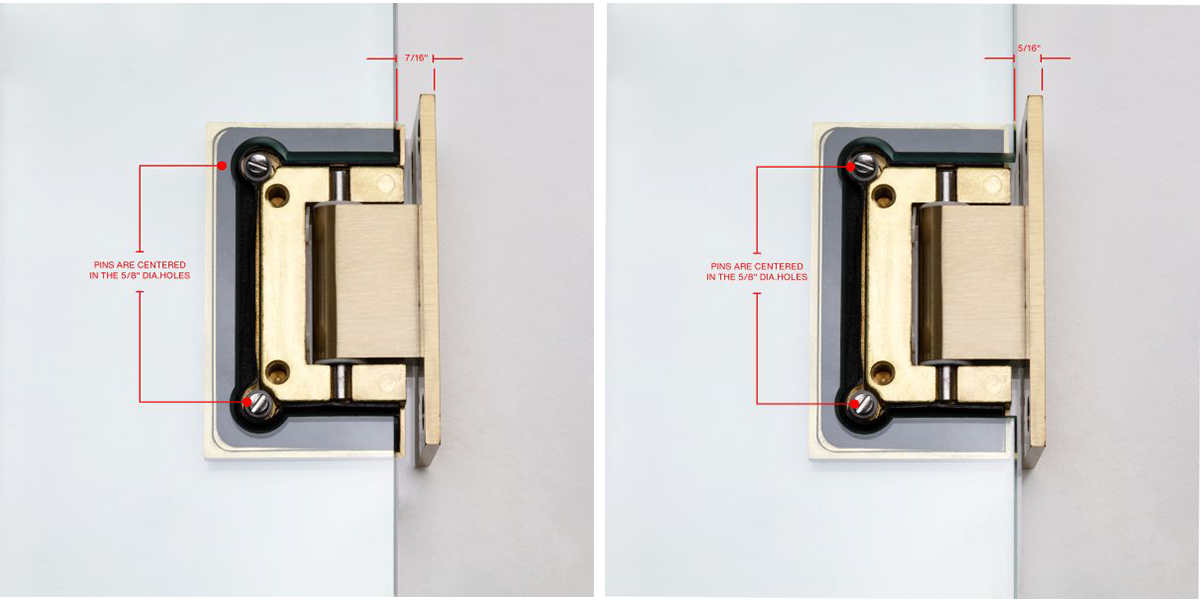
Above: Old template (left); new FHC template (right).
 Sometimes an industry does something a certain way for so long that nobody stops to ask a simple question:
Why are we still doing it this way?
That’s essentially what happened with the standard template used for 4-inch frameless shower hinges with removable “mouse ear” posts.
These hinges have been installed by millions over the years. They’re familiar. Installers know them. Fabricators know the cutouts. Manufacturers have supplied the same template for decades.
There’s just one problem: the template could have been better all along.
Installers Have Been Telling Us for Years
Talk to experienced frameless shower installers and you’ll hear a familiar complaint: I can’t get the glass close enough to the wall.
For a typical installation, the goal is approximately 1/4-inch clearance between the glass and wall. But the traditional hinge cutout can limit how far the hinge can be positioned into the glass, making that clearance difficult—or sometimes impossible—to achieve as intended.
Installers, being installers, figured out ways around it.
Some began modifying the standard template themselves to create additional adjustment room. Others removed the hinge’s mouse ear posts so the hinge could sit deeper within the glass cutout.
Both approaches addressed the symptoms, but neither answered the bigger question:
Why should an installer have to modify a manufacturer’s template—or remove part of the hinge—to get the installation they need?
That has left installers in an awkward position. Do you follow the manufacturer-supplied template exactly, even when field experience tells you it can create problems? Or do you modify it based on what you know works?
When experienced installers consistently feel the need to alter a template, that’s probably a sign the template deserves another look.
FHC Took Another Look
When FHC entered this category, we initially followed the established industry convention. After all, this basic hinge and cutout geometry has been used across millions of installations.
But “that’s how it’s always been done” isn't a particularly compelling engineering argument.
So, our team went back and looked at the relationship between the hinge, the mouse ear posts, the glass cutout and the adjustment installers actually need in the field.
The problem was hiding in plain sight.
Rather than expecting installers to compensate for the template, FHC reworked the template itself.
The revised FHC template allows the hinge to sit farther into the glass cutout, giving installers the ability to position the glass closer to the wall and achieve the desired clearance—without removing the mouse ear posts.
No field modification. No choosing between the supplied template and the workaround experience has taught you. Just a better template designed around how the hinge actually needs to be installed.
A Small Detail That Makes a Big Difference
This isn't a reinvention of the frameless shower hinge. And that's exactly the point.
Innovation doesn't always require adding complexity.
Sometimes it means paying closer attention to something everyone else has accepted as normal.
Versions of the conventional template have historically been supplied alongside comparable hinges from large and small manufacturers and suppliers, and FHC originally followed that same established convention as well.
But widespread use doesn't necessarily mean something can't be improved.
Installers had already identified the issue. Their field modifications were effectively telling the industry what needed to change. We just needed to listen.
For FHC, that's what product development should look like: understanding what installers are actually dealing with in the field, questioning established practices and improving the small details that can make their jobs faster, easier and more predictable.
In this case, it started with something as simple as a hinge template.
Because if installers have been modifying the instructions for years, maybe it’s time to modify the instructions.