
A Clear Leap Forward
Switchable privacy glass has come of age, delivering state-of-the-art performance to redefine versatility and function for a broad range of applications.
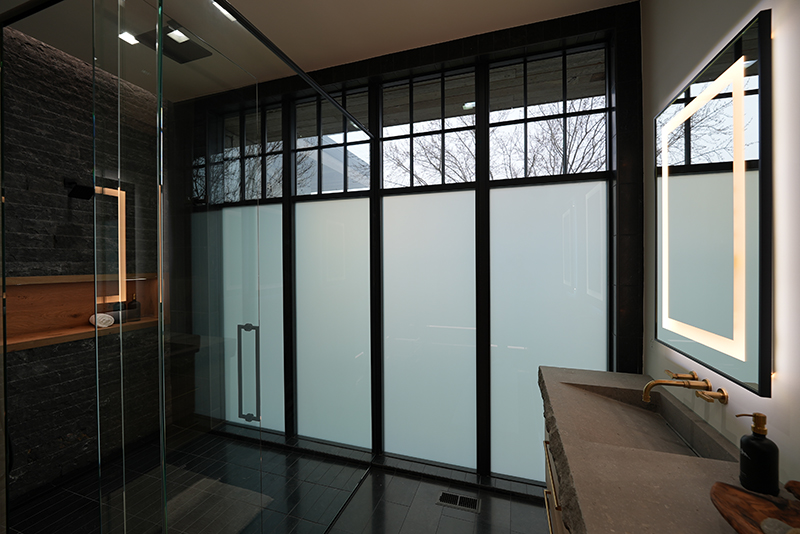
Switchable glass isn’t new. But to date, the technology has fallen short in essential ways that have stalled its broader commercial and residential adoption. In clear mode, panels appeared hazy and even distorted, especially when viewed from wide angles. In privacy mode, the glass looked unnatural and prevented too much daylight from flowing through. Transitions were often slow, durability and reliability were inconsistent, and the overall aesthetic felt out of place alongside traditional fenestration products.
As a result, the technology remained largely confined to interior office applications such as conference rooms, where “good enough” still delivered sufficient functionality with a tech-forward feel. Beyond these environments, however, adoption lagged for both interior and exterior applications. The window, door and partition industry settled into a holding pattern, intrigued by switchable glass but waiting for a breakthrough to deliver on its full potential.
While the industry waited, smart glass developers intensified their R&D efforts to engineer an optimized switchable glass solution. The breakthrough came through a new approach to the mechanism behind the clear-to-privacy transition, which delivered meaningful performance gains where they were needed most.
Cutting back on plastic
Traditional liquid-crystal privacy systems rely on polymers or internal films to hold the droplets in place, which can introduce haze, slow switching speeds and diminish color fidelity and visual warmth in privacy mode.
In contrast, polymer-stabilized cholesteric (PSCT) technology uses minimal polymer and no internal films. PSCT uses a cholesteric liquid-crystal helix stabilized by a thin polymer network instead of thick polymer matrices or plastic interlayers. In default mode, the helix scatters light to provide privacy.
When an electric field is applied, the structure reorients to a smooth, uniformly aligned state that allows light to pass directly through.
PSCT outperforms traditional liquid crystal for durability as well, resulting in world-class privacy glass that withstands the elements to protect homes and buildings.
The glass also consumes minimal energy — less than one third of a watt per square foot in clear mode, comparable to a small LED light — and requires no power at all in privacy mode. A complete low-voltage system, it connects with third-party building automation systems and smartphone apps to simplify installation.
Applications beyond exteriors
This newly optimized version of switchable glass is suitable for practically any space where sightlines, light infiltration and on-demand privacy are preferred at different times of the day. It serves as a dynamic layer of control, allowing commercial and public spaces to easily and instantaneously adapt to the immediate needs of the situation.
In healthcare, this capability is transformative. Patient rooms have long used manual curtains and blinds that require cleaning and introduce hygiene risks from dust and pathogens. Privacy glass replaces these shortcomings with quiet precision. Care teams can shift between visibility and discretion without entering the room, while patients retain personal control from their beds. The glass effectively creates a calmer, cleaner and more dignified environment that signals a superior standard of care.
In the workplace, the implications are equally versatile. Privacy glass resolves the tension between clear sightlines and private, blocked-off conference rooms. These rooms can sit centrally at the heart of the floorplan, inviting daylight to travel freely throughout the space, but with the option to instantly switch to privacy mode when needed. Interior glass can even double as a writable surface for collaboration. For high-sensitivity environments like investment firms, this same adaptability can extend to each individual office, ensuring confidentiality without sacrificing openness or light.
Some businesses are pushing the technology further, using the glass in private mode as a rear-projection surface that transforms storefront windows into dynamic, tech-forward displays that engage passersby.
In hotel rooms, the technology makes limited natural light go further. Replacing traditional walls with glass partitions allows natural daylight to reach typically dark spaces like bathrooms, reducing artificial lighting needs and energy use. Across hundreds or thousands of rooms and properties, this simple efficiency boost adds up to substantial cost savings and clear ROI. The glass also offers a sleek, modern aesthetic that helps hospitality brands stand out in a crowded market.
Inside the home, spaces no longer need to be fixed in purpose or mood. Interior applications, from bathrooms and home offices to full glass partition walls, can shift instantly from open and light-filled to totally private, while still allowing ambient light to flow through. Rooms also stay bright without the glare, creating more comfortable environments that are usable for more hours of the day. It’s a level of flexibility that opens new possibilities for controlling how a home feels as the day progresses and circumstances change.
Architects and interior designers should be excited about these game-changing advancements in switchable glass performance. So should window and door manufacturers, builders, smart home innovators and partition wall companies — not to mention every homeowner who wants to add a new level of control, comfort, and tech-driven sophistication to their everyday living.
The future of smart glass is here, and its impact is only beginning to unfold. More innovation is certainly on the way.