Defining High-Performance Facades
To push for higher performance in facades, clearer definitions and above-code criteria are needed.
There’s no standard definition of a high-performance façade: Ask 10 different people and you’ll receive 10 different answers. This is important not only because current above-code building programs have performance gaps, but also that neglecting standalone façade performance can have implications for life safety.
Creating a definition, and accompanying above-code certification program, was the cornerstone of the Façade Tectonics Institute’s (FTI) 10-point blueprint for accelerating the adoption of high-performance façades.
Current above-code certification programs miss the mark
Current above-code certification programs don’t consider the full range of performance factors. There are already building-level, above-code certification programs focused on energy efficiency, such as Energy Star for Commercial Buildings. There are others with a broadened focus on daylighting, and visual and thermal comfort, like the WELL Standard, ASHRAE 189.1 and LEED. LEED v5 also includes credits for considering lifecycle carbon and thermal resilience.
But meeting these above-code standards doesn’t guarantee a high-performance building envelope. Often, designers specify high-efficiency, higher capacity, HVAC systems to compensate for thermal losses and solar gains through the envelope. Thermal bridging is often ignored, air-leakage insufficiently controlled, and there is inadequate as-built quality assurance.
Some programs don’t consider the full range of performance factors. For example, Passive House design focuses on delivering exceptional thermal performance. This results in excellent thermal comfort and resilience, but it does not fully address daylight adequacy, visual comfort or lifecycle carbon emissions.
A façade’s stand-alone performance is critical – it is the only barrier protecting occupants from outside extremes in power outages. Any degradation in envelope performance stays with the building throughout its life, whereas HVAC systems are replaced on a much shorter lifecycle.
Above-code program supports market transformation
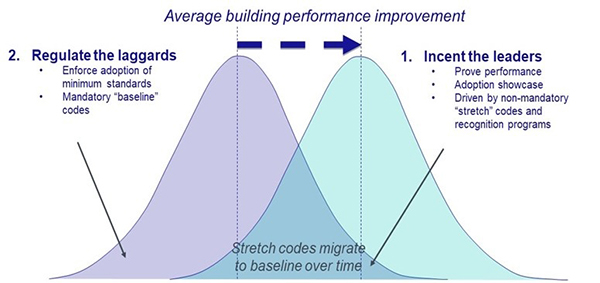
Because the stakes are so high, we must transform the market to make higher-performing envelopes an installed standard. There are two main approaches to market transformation.
1. Mandate higher performance through more stringent minimum codes:
Set and enforce the lowest legally allowable standard through mandatory codes. Increasing the stringency of the minimum codes can only move as fast as their cost-effectiveness rules allow. The increased cost-effectiveness of higher-performing systems is driven by wider market adoption, which helps reduce installed cost by increasing manufacturing economies of scale, and reducing the installation risk premium.
2. Incentivize the leaders to do better:
Incentivize (usually financially) the adoption of higher performance. This builds capacity in product availability, design, engineering and installation. It supports cost-reduction for “new and different” products and processes through economies of scale and reduces perceived risk. As costs come down, higher performance can be adopted by the mandatory minimum codes.
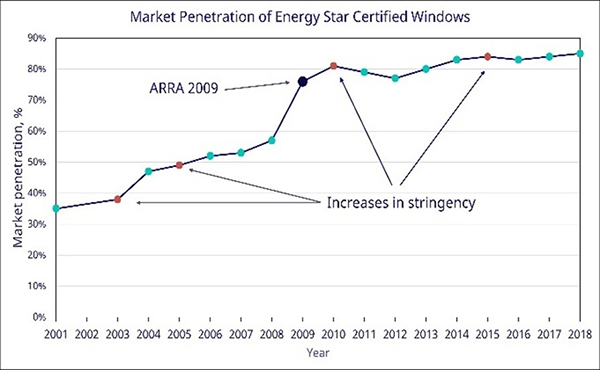
Typically, incentives need to be tied to a performance standard, certification program, or guideline. Federal tax incentives tied to the use of Energy Star-certified residential windows significantly increased market penetration of high-performance windows and stringency in code minimum performance (see figure 2).
Without an above-code program for high-performance nonresidential façades, it is impossible to tie incentives directly to improving envelope performance. Without widespread adoption of more stringent codes across the U.S. and without façade-specific incentive programs, our industry has no pathway for market transformation.
To help change this trajectory, FTI, funded by the Department of Energy, is outlining an above-code program structure for high-performance nonresidential/multifamily building façades. Learn more in my next blog.