
At GlassBuild, Creating a Legacy
Industry leaders urge family-owned businesses to plan leadership transitions
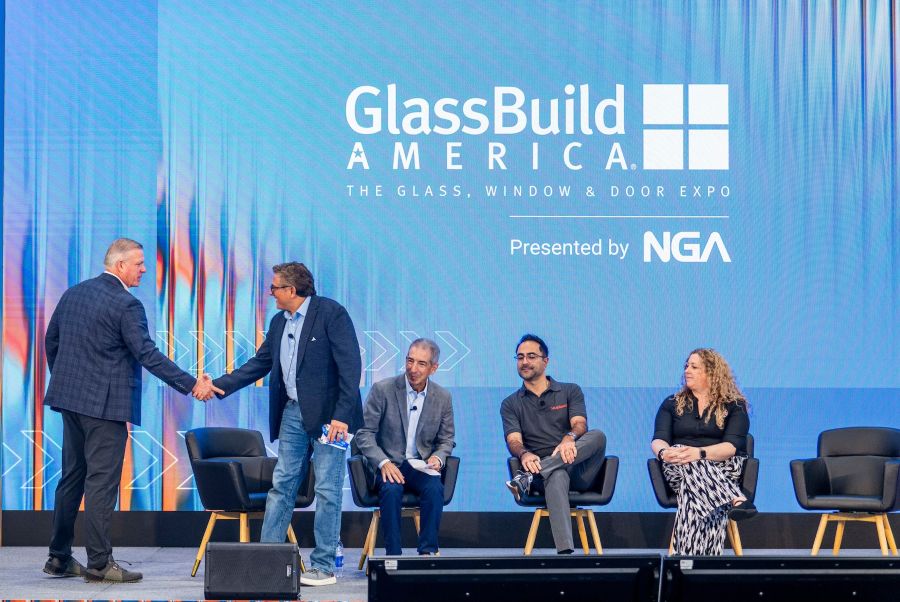
GlassBuild America 2026 showed what’s new in the industry: new technologies, new opportunities, and new collaborations. The skilled labor shortage remains a major driver of many innovations, especially automation and robotics. Speaking with glass company owners at the Family Business Breakfast on the final day of the show, the lack of labor can also lead to a loss of legacy if the next generation is not interested in the business. “We have a 50-year company, and no one to leave it to,” one owner shared with me.
Following the breakfast, a panel discussion—“Who's Next: Building the Leadership Pipeline That Keeps Your Company Strong and Protects Long-Term Value” — aimed to offer insights into creating succession plans for the unique and valuable types of companies family-owned businesses are.
Start planning early. Every panelist mentioned this. Babak Golriz, head of expanding markets at aluplast, a second-generation, family-owned German manufacturer of uPVC window and door extrusions, advised audience members to start the handoff while the older generation is still in the building, so culture and knowledge carry over. “Doing it early is very good because you have the time to have the continuity and an overlap between previous leadership and future leadership. … It’s better to come from a position of wanting change rather than needing change,” he says.
Trusted outsiders can bridge family transitions. Panelist Lori Benish was a longtime vendor contact at Oldcastle BuildingEnvelope before joining Enclosures Unlimited, a family-owned shower company. She moved it from handwritten tickets to software technologies and social media, and has hired about 75% of the current staff. Benish described her role as advocating for both the owners and the employees, which can be especially important when managing conflict. “I’m a bridge between the owners and [the employees], and I can be an advocate for them …to show each side what things can be done,” she says.
Private equity partnerships need honesty upfront. Panelist Jeff Goodman, senior operating partner at private equity firm the Riverside Co., advised owners to decide what they want before taking outside capital and selling their business. He underlined that PE is a “transitional owner” that buys in order to sell. “Once you cash the check, the world does change. So we really encourage folks to be honest: What do you want out of this?”
Control the narrative, or competitors will. Rick Dominguez of Jordon Glass Machinery, a third-generation family business, said that after his father’s passing, rumors spread that Jordon Glass would be acquired or might fold, and he didn’t hear about them until employees raised them. “If I could do it over again, I think what I would have had a greater formality in saying, ‘We’re fine,” he shared with audience members.
Disagree in private, and let the next generation fail safely. During the Q&A, intergenerational conflict came to the fore. After a question about difficulties in handing off the business to the next generation, a third-generation audience member advised current family leadership to let the next generation try new things, such as emerging technologies and processes, in a “controlled environment” while older family members are still there to offer guidance. “I’m exposing the business to new technology, new methods, new this and new that. I want to try. I need to fail to learn. And if it is a controlled environment, you’re still in control. … Do it now, before you’re not there anymore or you retire.”
And while resolving disagreements is crucial, Golriz advised attendees to make sure those conflicts are kept private. “It’s very important that this is happening behind closed doors and the organization is not exposed to these disagreements in public. There’s nothing worse than demotivating your organization and creating a culture of fear and uncertainty.”