
Façade Tectonics World Congress Examines Materials, Design, Performance
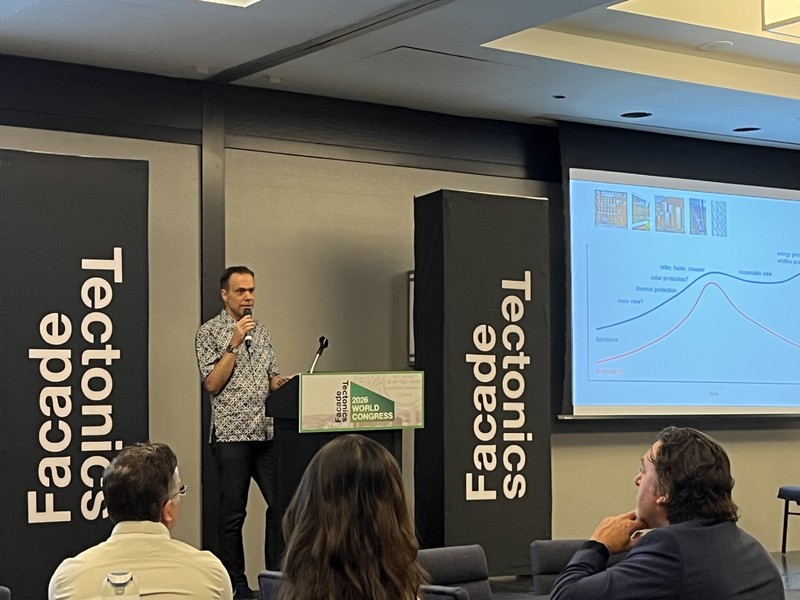
The Façade Tectonics Institute 2026 World Congress took place in Pittsburgh Sept. 28-Oct. 2. Approximately 300 building and design professionals registered for discussion and learning about facades—their materials, their design, their performance and more. This year’s call for abstracts yielded more than 130 submissions from around the world, which FTI reports is a record level of engagement.
Carnegie Mellon University’s School of Architecture served as the host school for this year’s World Congress. The university hosted several events, including a robotics and construction workshop and reception at the CMU College of Fine Art. In addition, 80 CMU students attended to listen to and learn from the presentations.
NGA at FTI
On Sept.30, Urmilla Sowell, VP of advocacy & technical services at the National Glass Association, and Georgia Oehler, NGA’s senior manager of technical services & sustainability, presented their paper on industry-wide sustainability efforts.
The presentation examined three concurrent industry-wide efforts demonstrating how collaboration with and within the architectural glass industry address systemic sustainability gaps in North America.
-
The rapid expansion of EPD development in the glass sector that reveals both the power and limitations of standardized disclosure in driving meaningful carbon reductions;
-
National Glass Association’s World of Glass Map and technical papers that address the fragmented state of glass recycling and create visibility into available infrastructure while highlighting geographic and material-type gaps;
-
and the joint recycling research project with NGA and the Aluminum Extruders Council that brings together manufacturers, processors, and waste management entities to quantify recycling barriers and identify scalable solutions.
Each initiative underscores a common reality: sustainability progress in architectural glass requires coordinated action across the supply chain, from raw material extraction through building decommissioning.
Low-tech, high-tech
Erik Olsen, Transsolar KlimaEngineering, keynoted Oct. 1, with his presentation, “The Future is Low-Tech. Is the Future Low-Tech?” His firm’s theory is to work with integrated design rather than add gadgets to achieve a high-performance building. Understanding what’s driving high-performance, he says, is what should inform basic design while also balancing design objectives.
At their base, facades provide shelter and privacy. Beyond that, though, they provide views, thermal and solar protection, energy production, wildfire protection and more. “For every function we add to a building, we add new technology,” he says. Olsen challenged the industry to understand technology’s role and value, and to make it less complex.
Olsen shared several examples. At the School of Design + Environment in Singapore, where the sky dome is very different than in North America and it’s uniformly bright, they implemented a deep overhang while still getting excellent daylight. Aggressive solar control on the façade, plus operable windows, meant they didn’t need to design in a supplementary cooling system in the building. Students and staff maintain thermal comfort in a building that’s often 84 F with ceiling fans. “Let’s make the future simple,” he said.
Shading and daylighting
Azadeh Sawyer, PhD, LEED AP, Carnegie Mellon University, and Alex Terzich of architecture firm HGA, shared their insight in their paper, “Simulation-based façade optimization for healthcare environments” with Pittsburgh’s UPMC Presbyterian Hospital as its subject.
The two-year project encompassed 900,000 square feet, 18 stories, 620 patient rooms and an all-glass façade. “The design intent was fixed before analysis began,” they noted, referring to the façade as “clinical infrastructure” wherein it helps with circadian regulation, shorter stays and faster recovery. Although glass helps with all of those goals, if daylight isn’t controlled it causes glare, overheating and thermal discomfort. Thus, simulation-based models were of paramount importance to find the right balance.
The team had to analyze for a southwest- and northeast-facing façade on the same envelope, with the southwest receiving twice as much solar radiation as the northeast side. They also couldn’t use horizontal solutions on the exterior or interior because of snow accumulation and dust shelf/cleaning concerns, respectively. Therefore, vertical fins became the starting point. Metrics examined spatial daylight autonomy, annual sunlight exposure, daylight glare probability and spatial discomfort glare.
The team also talked with and did post-occupancy studies with patients to garner quantitative data. Even in some cases where the hard data indicated a solution might be right, if patients mentioned discomfort or other concerns, they went back to the drawing board.
After many rounds of simulations and data collection, the team shared several takeaways:
-
You cannot optimize a single variable; it has to be a coupled decision.
-
Performance rank does not equal selection. The highest daylight simulations and best performance simulation in the first round failed when translated into a buildable wall.
-
Simulation bounds but it doesn’t choose. Cross-disciplinary coordination determines what is buildable.
Validation testing and prototype testing
Richard Green, façade designer, engineer and consultant at Green Facades LLC, discussed the differences between and importance of both validation and prototype testing. “Glass behaves in different ways and we don’t always know how to predict it,” he said. “Part of it is getting the testing right. Glass is unforgiving. Calculations are only as good as the failure mechanisms we can imagine. The greatest risk is that we didn’t do the right calculation.” Testing, said Green, must tell us what we want to find out.
Validation testing uses prior design and calculations and usually uses a small sample size, such as through ASTM or AAMA standards, he says. It demonstrates there’s not something fundamentally inadequate with the design proposed.
Prototype testing, meanwhile, is a statistically significant proof of design and usually involves multiple tests. “If you want to see if something is going to work, build a prototype, test the living daylights out of it and see what’s right,” he says. He also recommends testing to failure. “You’ll learn far more from breaking it. You won’t know where its point of failure is until it fails.”
FTI at GlassBuild
FTI founder Mic Patterson served as the emcee at the opening Keynote Theater presentation at GlassBuild America, Sept. 23-25, in Las Vegas. He presented the project and people awards for the Glass Magazine Awards and Window + Door Awards before introducing the keynote speaker, Daymond John, star of ABC’s Shark Tank, entrepreneur and CEO of FUBU.
Plus, the Main Stage at GlassBuild America brought FTI’s expertise to the show floor with a recycling and reuse panel featuring Patterson; Sophie Pennetier, founder and CEO at Digne; and Stephen Selkowitz, principal at Stephen Selkowitz Consultants.