
How Preconstruction Makes Profit Clear
Why preconstruction is becoming the glazing industry’s most important margin protection tool
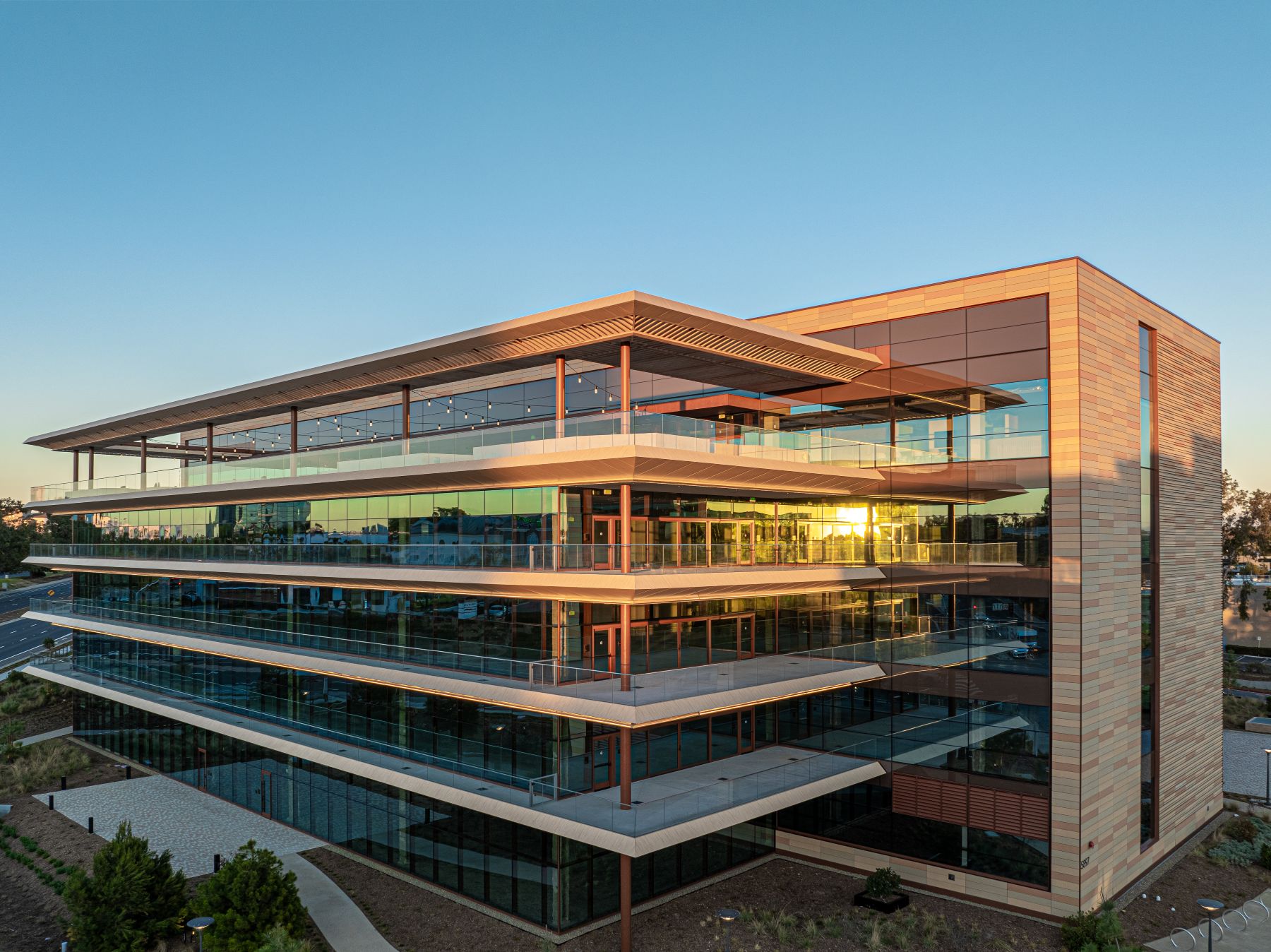
Above: OBE360 served as design-assist partner on this 323,000-square-foot LEED Gold-pursuing biotech campus, adapting the Reliance Unit Wall system to meet demanding seismic, wind load, and energy requirements alongside architect HOK and glazing contractor Lunstrum Windows.
The June AIA/Deltek Architecture Billings Index (ABI) indicated that market conditions remain soft and are still declining, but at a slower pace despite a difficult and uncertain market. On a positive note, project inquiries have remained relatively strong and generally improved over the past two years, indicating that demand is still in the market. In addition, the AIA Consensus Construction Forecast Panel adjusted its 2027 nonresidential spending forecast from 2.2% to 3%, reflecting growing optimism about longer-term market conditions.
What this signals is the challenge in the construction market is not a lack of opportunities, but increased uncertainty and longer timelines with projects moving more slowly as owners weigh budget, financing, and timing concerns. The work is out there, but it’s less predictable and taking longer to convert.
That uncertainty is driving a broader shift in how architecture firms and building teams are thinking about their business. The focus is no longer just on winning more work, but on making money on the work already secured.
For glazing contractors and glass manufacturers, this is not a new concept. In many ways, the glazing industry has been operating in a reality where early decisions often determine whether a project preserves margin or erodes it. Many in the industry feel that clearer preconstruction collaboration can help protect profit and lead to better project outcomes.
For Troy Hein, program manager at OBE 360 Design Services Group, preconstruction is fundamentally about proactive collaboration and risk mitigation. It requires teams to think beyond drawings and consider how a system will actually be fabricated and installed.
“Just because you draw it doesn’t mean we can build it,” he says, highlighting the persistent gap between design intent and real-world constraints. Whether the issue is constructability, performance, or cost, the root cause is often the same: scope, schedule, and budget were not fully vetted early enough.
How the Facade Impacts Profitability
For Matt Kamper, director of preconstruction at Woodbridge Glass, the facade is far more than a cost component: it’s also a key driver of project-wide profitability.
The facade is one of the few systems that directly influences both the economics and the perception of a building. It shapes marketability for owners, drives design trade-offs for architects, and introduces cost and execution risk for contractors and glazing teams. In Kamper’s words, “[Facade decisions] impact costs at every level,” reinforcing that early decisions carry outsized financial consequences.
“A specified item might be a fantastic product, but wrong for a project’s needs, leading to budget excess and/or unnecessary risk,” says Justin Russell, vice president of preconstruction at Enclos. System selection, material choices, tolerances, and sequencing strategies all influence whether a project runs smoothly or becomes a source of friction and cost overruns.
Where Margin Is Lost
Margin loss is rarely the result of a single issue. More often, it begins with early assumptions that fail to fully account for performance requirements or constructability, and compounds later through field conditions and coordination challenges.
Kamper summarizes margin loss plainly: “It’s twofold … in preconstruction, if something is missed…[and] in the labor in the field.” For Russell, “margin loss catches up in the field.” Early input helps refine and support the goals of any project, but “reacting downstream is what erodes margin.”
In other words, both early decisions and execution determine the outcome. By the time construction begins, many risks are already embedded in the project, with limited ability to recover them.
Without proper preconstruction planning, these risks can show up several ways during project execution:
- Facade systems that are over-engineered or misaligned with fabrication capabilities;
- Custom geometries that introduce unnecessary complexity;
- Late-stage material changes that disrupt procurement;
- Poor trade coordination, resulting in cascading Requests for Information and redesign.
By the time these challenges appear on site, they become cost problems, not design problems. Unfortunately, someone in the project chain has to absorb them.
Preconstruction as a Margin Protection Tool

This is where preconstruction shifts from a nice-to-have service to a strategic lever.
At its best, preconstruction is not just estimating or budgeting. It functions as a margin protection system for the entire project team:
- Owners and developers gain clearer cost certainty, experience fewer surprises, and enjoy better alignment between design intent and budget;
- Architects benefit from more buildable designs, reduced downstream liability, and stronger fee justification;
- Contractors see fewer change orders, tighter schedules, and improved coordination
- Manufacturers and fabricators achieve more predictable production, less variability, and improved margins.
For glazing subcontractors, preconstruction is where design starts to meet reality. Enclos’ Russell describes it as an effort that extends far beyond a single team. “Preconstruction supports all facets of our business … engaging operations and field personnel helps bring ideas to execution.” That integration is what allows early ideas to hold up under real-world conditions. Without it, decisions made during design often fail when they encounter fabrication constraints or field logistics.
Firms like Woodbridge Glass and Enclos are brought in early to help translate design intent into systems that can actually be fabricated, coordinated, and installed. This is often through a mix of engineering input, budgeting, and trade coordination.
Glass manufacturers are also formalizing this early involvement through design-assist models. OBE 360 Design Services Group functions as a partner that works alongside the project team early to develop glazing solutions that are practical to fabricate and execute. Kawneer Collaborative takes a similar approach, staying engaged with the project team from concept through delivery to help shape facade systems that align with real-world budget and schedule constraints.
Rob Huffman, director of sales and sales operations for Kawneer Collaborative/Cranberry, approaches that same equation from a slightly different angle. “In the preconstruction world, we look in reverse order: budget, schedule, and scope,” he explains. Thinking of it in this way ensures the project is properly funded before developing solutions. In many cases, the issue isn’t that the project became too expensive, but that the design never matched the available budget in the first place, he says.
“Preconstruction takes the project to an awardable condition,” he adds, meaning the scope is fully defined, coordinated, and buildable before it goes out to bid. Without that alignment, “scope gap kills.” Those gaps don’t disappear, but resurface later as cost overruns, delays, and friction across the project team.
Timing Is Everything: The Value of Early Collaboration
If preconstruction is the tool, timing determines its effectiveness. While in many construction processes, stakeholders and trades may complete their work in order, and separately, preconstruction is most effective when stakeholders are engaged early on and work collaboratively throughout.
For glaziers and glass manufacturers, this means instead of waiting to be called to the table, they are collaborating with the architects, owners and general contractors all throughout the process. Armed with information early, the decision becomes informed instead of assumed. This shift allows teams to align on goals upfront, reduce rework, and shape the project instead of reacting to problems later.
Timing is particularly critical for the facade. Mechanical and HVAC systems are typically introduced early, and their performance requirements often influence major building decisions before glazing is even part of the discussion. As Kamper notes, “Before the end of schematic design … definitely during design development. At construction documents, sometimes things are way too far down the line.”
Yet while HVAC systems operate in the background, the facade is what people see and experience. It is a primary driver of perceived value, and one that is often introduced too late. Earlier involvement from glazing teams allows project partners to balance design and performance, improve budget certainty, and reduce the need for late-stage value engineering, where changes are more disruptive and costly. As Russell puts it, early alignment “limits rework and design decisions that excessively drive up budgets.”
Where the Conversation Needs to Go Next
Despite its clear advantages, early engagement of glaziers and glass fabricators continues to face familiar barriers: resistance to upfront costs, concerns about limiting competitive bidding, and a lingering design-bid-build mindset.
OBE’s Hein reframes the issue as “we’re just moving money to the left.” In other words, preconstruction is not an added cost, but simply a shift in when that investment occurs, rather than an added-in cost due to failures during preconstruction. “We’re going to have to collaborate … let’s do it while everybody’s in a good mood,” he says.
He also highlights a structural gap in the process. Because general contractors typically do not purchase directly from manufacturers, their input is often missing early. The result is a fragmented workflow where information is withheld or siloed rather than shared.
“You build trust through the exchange of information, helping them get to where they want to go” says Huffman. Preconstruction is not just about technical coordination. It’s also about relationship-building that improves outcomes over time.
To bring structure and clarity to preconstruction engagement, Huffman outlines a consistent process: initial consultation, conceptual detailing, preliminary engineering, product samples for visual alignment, and budget validation — followed by a discussion on whether the project warrants a contractual arrangement.
“We certainly welcome a commitment,” he says, “but understand circumstances may not enable that.” The goal is not to force early decisions, but to create a clearer path forward —one where risks are identified early and outcomes are more predictable.
Profit Starts Before the Bid
In an increasingly unpredictable market where architects continue to push the boundaries of facade design and performance, protecting margins has become more complex and more critical than ever. In this environment, margins are no longer protected by reacting to problems in the field. It’s protected by preventing them in the first place.
Preconstruction gives building teams and stakeholders the clarity to make better decisions earlier, when changes are still manageable and costs are still controllable.
That doesn’t mean every project requires a fully engaged preconstruction effort. Simpler, well-defined scopes can still follow a traditional path. But as complexity increases, whether driven by design ambition, performance requirements, or schedule pressure, the value of early engagement becomes harder to ignore.
Because in today’s environment, profit isn’t won at bid day. It’s decided long before it.