
Where Privacy and Openness Meet in Interior Design
A More Nuanced Approach to Privacy in Interior Design
Bottom line:
- Decorative glass helps hospitality designers balance openness and privacy by calibrating visibility rather than fully separating or exposing spaces.
- Different glass types each offer distinct ways of managing light transmission, diffusion, and reflection.
- Glass partitions and panels can define spatial boundaries without disrupting flow, so guests feel oriented without feeling confined.
- Layering multiple glass types within a single project creates cohesive, atmosphere-rich interiors where functional shifts are expressed through subtle material changes.
Privacy has become less about separation and more about calibration. In hospitality environments, where openness is often tied to atmosphere and guest experience, fully enclosed spaces can feel abrupt while complete transparency can leave little room for comfort.
Designers are increasingly navigating the space between these extremes, using materials that allow light to move freely while adjusting how much is revealed. Decorative glass has emerged as an effective tool in this effort. Rather than functioning as a final layer, decorative glass now shapes how interiors are organized and experienced. It defines boundaries without interrupting flow, softens transitions, and introduces material depth in high-traffic environments.
As expectations around comfort and personalization continue to evolve, the ability to fine-tune visibility without sacrificing openness has become central to how hospitality interiors are conceived.
Calibrating visibility through material choice
Not all glass performs in the same way, and the distinctions between types are less about appearance and more about how they mediate light and perception. Reeded, frosted, patterned, and antique mirror glass each operate along a spectrum of diffusion, obscurity, and reflection.
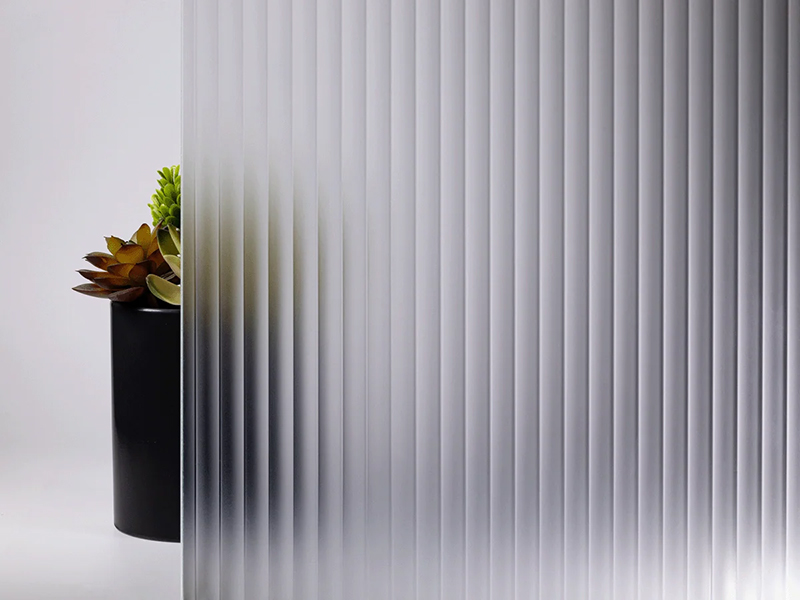
Reeded glass, often referred to as fluted glass, introduces linear texture that partially obscures direct views while maintaining strong light transmission. Its vertical rhythm softens sightlines without disconnecting adjacent spaces, making it particularly effective for partitions in restaurants, lounge areas, and open-plan lobbies. Movement remains visible, but detail is reduced, allowing for a sense of activity without visual noise.
Frosted and acid-etched glass shifts the balance further toward privacy. By scattering light more uniformly, these finishes obscure detail while preserving brightness. In guest room bathrooms, spa environments, and back-of-house transitions, this level of diffusion supports discretion without creating the closed-off feeling associated with opaque materials. The result is a softer visual field that feels consistent rather than segmented.
Patterned glass introduces a more varied approach. Depending on the scale and geometry of the pattern, it can range from lightly diffusive to highly obscuring. In hospitality settings, patterned glass is often used to define thresholds, such as between a lobby and a bar or a corridor and a lounge, where a degree of separation is needed but continuity remains important. The pattern itself becomes a regulating device, filtering both light and visibility.
Antique mirror glass operates differently, relying on reflection rather than transmission. Its softened, often mottled surface reflects light back into a space without the sharpness of a standard mirror. This creates ambient illumination while subtly expanding perceived volume. In bars, reception areas, and guest rooms, antique mirror surfaces introduce depth and warmth, contributing to atmosphere without drawing attention to themselves as reflective elements.
Defining space without closing it off
As hospitality interiors become more fluid, the need for clear spatial organization remains. Decorative glass lets designers establish boundaries that are legible but not rigid.
Partitions made with reeded or patterned glass can separate dining zones, waiting areas, or coworking spaces while maintaining spatial continuity. Guests can orient themselves within a space without feeling confined, and staff can maintain awareness across different zones. This balance is particularly valuable in multiuse environments.
Doors and enclosures also benefit from this approach. Sliding or pivoting glass panels with textured or frosted finishes allow spaces to open and close as needed, adapting to changing levels of activity or privacy. Rather than creating a binary condition of open or closed, these elements introduce a gradient that aligns more closely with how hospitality spaces are actually used.
Light as a shared resource
Light rarely belongs to a single space. In large hospitality environments, daylight must often pass through multiple zones, each with different functional and atmospheric requirements. Decorative glass enables this shared use of light by redistributing it rather than blocking it.
Reeded and patterned glasses diffuses incoming light, reducing glare in high-traffic areas without reducing overall brightness. This contributes to visual comfort, particularly in lobbies and circulation zones where lighting conditions shift throughout the day. Frosted glass extends this effect into more private areas, so light continues to move through the space even as visibility decreases.
Antique mirror surfaces play a complementary role by reflecting light into deeper parts of an interior. In spaces with limited natural light, this helps balance illumination levels. The reflection is subtle, avoiding the harsh contrasts that can occur with more reflective materials.
Layering materials for atmosphere
The most effective applications of decorative glass often involve layering multiple types within a single project. Rather than relying on a single solution, designers can combine diffusion, obscurity, and reflection to create a more nuanced environment.
A restaurant might use reeded glass for perimeter partitions, patterned glass for feature screens, and antique mirror behind a bar, while guest rooms might pair frosted glass in the bathroom with an antique mirror accent in the entry. These combinations allow each material to perform where it is most effective while contributing to a cohesive overall atmosphere.
A layered approach reduces visual friction. By keeping light and material behavior consistent across spaces, interiors read as continuous rather than segmented. Guests move through environments that are varied but coherent, where changes in function are reflected in subtle shifts in material rather than stark contrasts.
Integrating glass into the design process
The performance of decorative glass depends on how it is specified and integrated. When introduced early in the design process, it can align with architectural systems, lighting strategies, and millwork detailing. This coordination means glass can function as part of the spatial framework rather than as an applied finish.
Fabrication plays a critical role. Pattern scale, opacity, and finish must be considered alongside dimensions, safety requirements, and installation methods. In hospitality projects, precise coordination helps reduce on-site adjustments and supports more efficient installation.
By treating decorative glass as a material system, designers gain greater control over how spaces are experienced. The relationship between light, visibility, and reflection becomes intentional, not incidental.
Toward more considered interiors
Designing for privacy no longer requires pulling spaces apart. Instead, it depends on how precisely a material can edit what is seen, what is felt, and how light moves between them. Decorative glass operates within that margin of control, allowing interiors to remain connected while still offering moments of retreat.
Used with intention, it does more than resolve functional constraints. It establishes a quieter order, where boundaries are implied rather than enforced and where light continues to define the experience from one threshold to the next.