ZAK World of Facades in Washington Concentrates on Adaptive Reuse, Sustainability
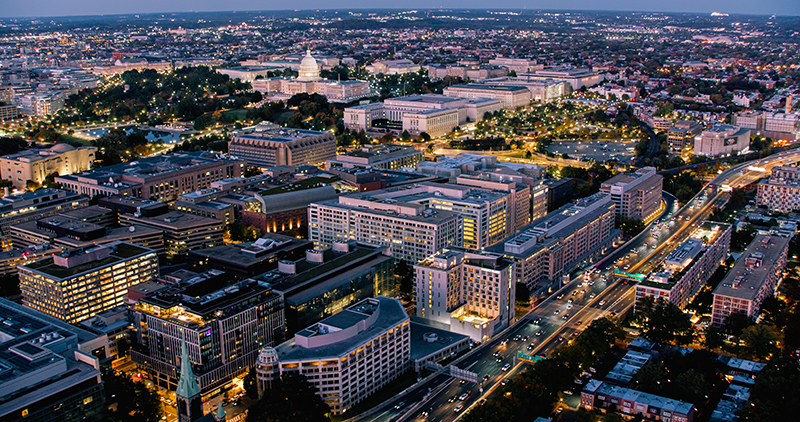
ZAK World of Facades, a conference focused on façade design and engineering, was held March 19 in Washington, D.C. Many featured educational sessions were tailored to the host city’s built environment, and adaptive reuse and sustainability emerged as major themes. Glass was a throughline of the conference, praised for its daylighting capability and design versatility. “Glass is such an ethereal material, because it can both reflect or be transparent,” says Jason Wu, Associate, BIG.
Several case studies offered ways to maximize glass’s daylighting potential thoughtfully, often in combination with other building materials.
Here are a few takeaways from the conference.
Adaptive reuse provides opportunities and challenges
Given the historic built environment in the D.C. area, it followed that several presenters focused on adaptive reuse. Colin MacKillop, principal at Quinn Evans, kicked off the educational sessions with an overview of the recent revival of the National Air & Space Museum. The restoration required architects to update the building envelope to provide modern performance while maintaining the museum’s iconic look, while also providing protection to the precious artifacts inside. The designers ultimately used high-performance double glazing for some areas of the exterior with a graduated ceramic frit pattern and seasonally-adjusted solar shading. The solution allows enough daylight to showcase the museum’s aircraft while also preventing damage from sun glare.
Beyond adaptive reuse of historic buildings, the conversion of office buildings to residential spaces has become common in many regions, according to presenter Amanda Stacy, AVP – Building Enclosures & Dept. Head, DC, WSP, who says that D.C. is one of the biggest markets for this type of reuse given its high office vacancy rate. Stacy reviewed several important considerations for designers to consider when adapting the building, including the higher relative humidity load of residential spaces—due to bathing and cooking—and the different structural load that residential conversion can incur.
Given D.C.’s function as the nation’s capital, the built environment also requires more security considerations, including for entrances to landmarks like the Washington Monument, which now features a glass-enclosed security checkpoint area for visitors. Morgan Reynolds, associate principal of Thornton Tomasseti, the project designer, says that while the original security area, installed after the 9/11 attacks, was fairly makeshift, the firm was asked to create something slightly more permanent. To avoid a “bunker”-like look, the team used several kinds of security glass in order to emphasize both “transparency and privacy” Reynolds says. While the exterior is wrapped in blast-resistant systems, the interior features ballistic and forced-entry resistant glazing nearer the access point to the Monument.
Sustainability practices include biophilic design and lifespan considerations
Presentations included common sustainability concerns, including material recyclability, embodied carbon and operational performance. Biophilic design, or the connection of building occupants with nature and the outdoors, was also a consistent theme in presentations. In discussing his firm’s construction of the new student center on Johns Hopkins University campus, BIG’s Jason Wu explained that designers took inspiration from the natural environment, using mass timber and expansive windows to create a connection with the outside. “When you’re in the building, you almost forget you’re indoors because of how open it is,” he says.
Daylighting solutions should be thoughtfully adapted to the purpose of the building, according to panelists for the session Biotech Facilities: Understanding How Facades Can Create a Healthy Internal Environment.” The environment inside biotech and lifescience facilities need to be carefully controlled, they explained, requiring specific humidity and pressure levels. The solution in one case study offered by Tyler Grimshaw, Principal Architect, EwingCole, was to use fritted glass as well as vertical louvers for the exterior facade.
Presenters also discussed designing beyond first generation tenants, and thinking about the longevity of the building and its performance over time. “I don’t just think about the first generation tenant, but also the second, third and even fourth generation,” says Daniel Lucenti, senior project director, design & construction, Wexford Science & Technology.