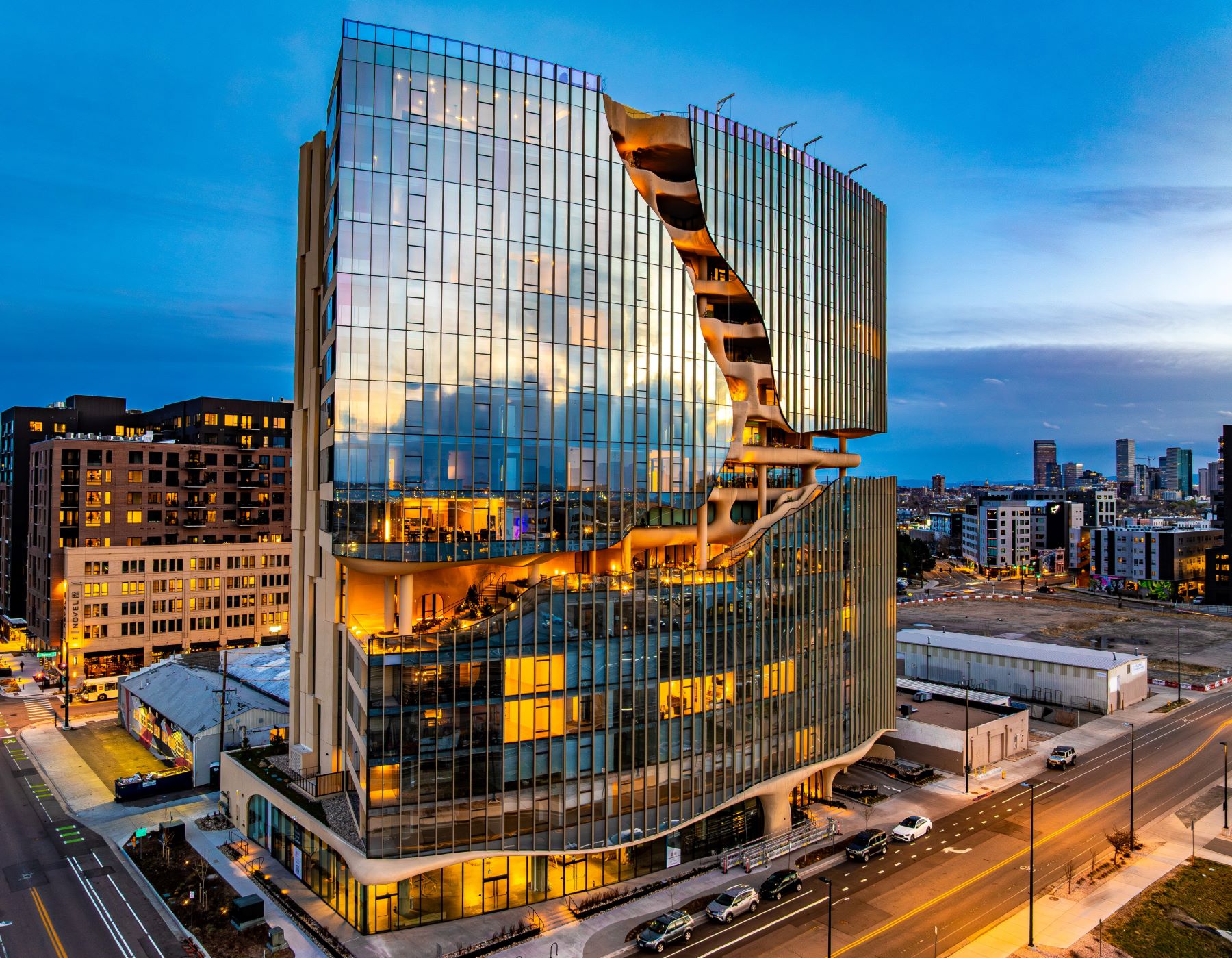
Above: 2025 Project of the Year Winner, One River North. Submissions to the 2026 Glass Magazine Awards are open.
The March edition of Glass Magazine is our yearly Architect’s Guide. It’s designed to speak directly to the architect and design community, and to highlight exactly what makes glass such a unique building material. Here are just a few reasons that glass is a powerful and dynamic part of the built environment.
Glass is secure. Security and safety remain on many people’s minds, especially to protect vulnerable facilities like schools. In this year’s Architect’s Guide to Protective Glass, find an overview of all the protective qualities that glass can offer, from fire-rated glazing and life safety, to protection and impact-resistance. For a real-life case study, check out Protecting the Past, which profiles the Cathedral Church of the Redeemer in British Columbia to see how retrofit protective glazing helped to support the structure’s continued safety.
Glass is sustainable. One of glass’s most sustainable attributes is its infinite recyclability—it can be recycled and reused as glass as many times as needed with no loss in quality. Many in the industry are attempting to expand glass recycling efforts, including Infinite Recycled Technologies. The company recycled all the glass from last year’s GlassBuild America in Orlando, diverting 14.3 tons of glass from landfill. Vice President for Sustainability and Technical Initiatives Stanley Yee outlines that process, as well as the company’s other recycling ventures in this issue. For more on the current state of glass recycling and infrastructure, check out the Architect’s Guide to the Glass Recycling Supply Chain and the Architect’s Guide to Glass Sustainability, both available on GlassMagazine.com.
Glass is high-performance. Many in the architecture and design community are leading the charge on climate mitigation and reducing the environmental impact of buildings. With evolving glass technologies like vacuum-insulating glazing and multi-cavity glazing systems—which can include triple-pane or even quad-pane insulating glass units —there are more energy-efficient options than every before. And while embodied carbon remains a concern, so does the operational promise of glazing systems. For more on understanding the complexity of glass’s environmental impact, find a perspective on this question from Helen Sanders, Technoform.
Glass is beautiful. Since it became a standard building material in the middle of the twentieth century, glass has transformed from a sturdy product to one that pushes the design envelope. This last year’s Glass Magazine Award winners demonstrated that yet again, with winning projects showcasing the full spectrum of what glass can do. Taking home the project of the year was One River North, a mixed-development high-rise with a glass facade bisected by a “living canyon” that runs through the exterior like a river. These superlative projects expand the cultural imagination about how glass can help achieve design goals. If you have a project that features glass, please consider nominating it for a Glass Magazine Award.
Have glass questions? We have glass answers. If you’re an architect looking to understand more about architectural glass and glazing, join us for a brand new event the NGA Glass Fabricator Conference (GFAB), to be held June 14-17 in Chicago. The event brings together lead leaders in glass fabrication, along with their supplier partners, to discuss what’s possible with glass. The event will include a day of programming relevant to architects and designers, feature project case studies, trends in glass fabrication, and a discussion of glass in the interior. Architects will be able to earn HSW credits.